

 Language
 русский
 中文简体
 Español


How Many Watts Can a 16 Amp Socket Handle? A Practical Guide for Buyers
A maintenance engineer in a Bavarian workshop stood in front of a wall socket marked 16 A, 230 V, holding a 5 kW infrared heater that had just been delivered. The product label said the heater needed a 16 A supply. The engineer knew that 16 A multiplied by 230 V equals 3,680 W, so a 5,000 W heater would draw roughly 21.7 A at 230 V, far beyond what the socket could deliver. The correct termination was a 32 A CEE connection, not a 16 A socket.
That single calculation prevents most overload situations. Yet the real question of how many watts a 16 amp socket can handle goes much deeper. The nominal wattage changes with the local grid voltage. The safe continuous wattage is lower than the nominal value. The cable feeding the socket, the quality of the contacts, the type of plug, and whether the cable is coiled on a drum all affect the amount of power that can be drawn without overheating.
The short answer for most of Europe: a 16 A socket on a 230 V supply is rated for 3,680 W maximum, and roughly 2,940 W for continuous use lasting more than three hours. On a 240 V supply the maximum reaches 3,840 W; on the old 220 V standard it would be 3,520 W. This guide explains where those numbers come from, why they differ, and what a buyer should verify before relying on them.
The Basic Calculation: Watts Equal Volts Times Amps
For a single-phase alternating current circuit, the active power of a resistive load is calculated with the formula:
Power (W) = Voltage (V) × Current (A)
A 16 A socket therefore has a nominal power rating that moves with the voltage available in the installation. The table below shows the nominal maximum and a conservative continuous-load value at the voltages most often encountered in international power distribution.
| Supply voltage | Nominal power (16 A) | Recommended continuous load (80% of 16 A) |
|---|---|---|
| 110 V | 1,760 W | ≈ 1,410 W |
| 220 V | 3,520 W | ≈ 2,820 W |
| 230 V | 3,680 W | ≈ 2,940 W |
| 240 V | 3,840 W | ≈ 3,070 W |
The continuous-load column follows the common engineering rule of loading a socket to no more than 80% of its current rating when the load stays on for more than three hours. The reason is thermal, and the next sections explain it in detail.
Three-Phase 16 A Sockets
Industrial CEE sockets also come in three-phase versions rated at 16 A. A three-phase socket delivers power over three phase conductors at 400 V between phases. For a balanced resistive load, the apparent power is √3 × 400 V × 16 A ≈ 11.1 kW. This is why a red five-pin CEE socket is used for machines that would be impossible to run from a single-phase 16 A socket. In motor circuits, the useful watts are lower once power factor and efficiency are applied, but the 11 kW figure is the right starting point for cable and breaker sizing.
Why the Answer Changes with Supply Voltage
There is no single universal wattage for a 16 amp socket because the same socket delivers different power at different operating voltages. In the European grid, the nominal voltage is 230 V with a tolerance band that in many countries allows voltages between 216 V and 253 V. Some regions still operate near the historical 220 V level, while others see values closer to 240 V, especially in areas served by older 240 V distribution systems.
The chart below visualises the same 16 A current applied at the four voltage levels most relevant to international product specification.
If a supplier datasheet says max. 3,500 W, the value is probably based on 220 V or includes an extra safety margin. If a technician quotes 3,840 W, the calculation likely assumed 240 V. Both figures can be correct for different markets, which is why the voltage must always be stated together with the wattage.
Regional Supply Voltage and Plug Systems
For buyers who import equipment or manage facilities in several countries, matching the current rating is only one step. The physical plug standard must match the local socket network as well.
- Continental Europe: Schuko and French sockets are commonly rated at 16 A. A household socket on a 16 A circuit can supply 3,680 W at 230 V, but many European household circuits are protected at 10 A or 16 A depending on the room and the appliance.
- United Kingdom: BS 1363 sockets are rated at 13 A, and the ring circuit uses fused plugs. A dedicated 16 A industrial socket is used for single large appliances and normally feeds one machine only.
- North America: the supply is 120 V / 208 V / 240 V depending on configuration. A 16 A connection at 120 V delivers only 1,920 W; at 240 V the same current reaches 3,840 W.
- Japan: the domestic supply is 100 V. A 16 A circuit would be limited to 1,600 W, which is why Japanese appliances usually demand 1.5 kW or less from a wall socket.
These differences underline a practical purchasing rule: never quote a wattage without quoting the voltage assumption. A product card that reads 16 A, 230 V, 3,680 W is complete; one that reads simply 3,500 W should be treated as an approximation.
The Continuous-Load Rule: Why 16 A Is Not Meant to Run at 16 A Forever
Electrical sockets are tested under defined conditions, including a current that produces a certain temperature rise. When a socket is loaded to its full nominal current continuously, heat generated in the contact points and the cable terminals accumulates faster than the housing can dissipate it. The result can be softened plastic, weakened contact springs, higher resistance, and eventually a burned contact.
Installation guidelines for building services commonly treat any load lasting more than three hours as a continuous load, and for such loads the circuit components are derated to 80% of their nominal rating. For a 16 A socket this means the design current should not exceed 12.8 A, which at 230 V equals about 2,940 W. The rule is not a legal formula in every country, but it is a wise engineering margin that protects both the socket and the equipment connected to it.
This directly affects real equipment choices. A portable electric heater that runs all day, an electric water heater that cycles frequently, and a Mode 2 EV charging cable that charges a car for six hours are all continuous loads. Each of these should be planned with the 80% rule in mind, not with the theoretical absolute maximum in mind.
In the second chart, 12.8 A and 2,940 W represent the recommended ceiling for a load that stays switched on for several hours. Anything above that figure should be treated as an intermittent-load case, and the socket should be monitored for warmth during the first minutes of operation.
The Wiring Behind the Socket Limits Its Real Capacity
The socket is the last link in a chain that starts at the consumer unit. If the cable feeding the socket cannot carry 16 A without excessive voltage drop and heating, the socket rating is meaningless. European installation practice generally requires a minimum of 2.5 mm² copper for a 16 A circuit installed by standard methods. A 1.5 mm² cable is normally protected at 10 A and should not feed a 16 A socket unless the local code and installation method specifically permit a higher setting.
Voltage drop becomes important on longer runs. A 2.5 mm² copper conductor has a resistance of roughly 7.4 Ω per kilometre at room temperature. For a 25 m run in a conduit, the out-and-back resistance is about 0.37 Ω, and at 16 A the voltage loss reaches about 5.9 V. On a 230 V system that is roughly 2.6%, within the common 3% limit for power circuits, but already noticeable. Double the run to 50 m and the loss exceeds the normal limit. The appliance receives less than 230 V, a motor draws more current to produce the same mechanical output, and the temperature of the whole circuit climbs.
Flexible cords also carry their own classification, and the wrong jacket material causes premature failure:
- H05VV-F: PVC flexible cord for indoor appliances. Good for dry, warm environments, but not for repeated outdoor exposure or heavy mechanical stress.
- H05RR-F: rubber-sheathed flexible cord for medium-duty use. More resistant to moisture and abrasion than PVC, and suitable for many outdoor applications.
- H07RN-F: heavy-duty neoprene rubber cord for industrial and construction use. It resists oil, weathering, and mechanical damage much better and is the usual choice for site distribution.
For a 16 A extension cord, conductor size matters as much as jacket material. A 1.5 mm² cord can be used for a 16 A socket only over very short distances and with a correctly rated plug termination. A 2.5 mm² cord is the safer basis for any extension longer than a few metres. More detail on matching the cord to the load appears in our guide on selecting a high-load extension cord.
One fast way to eliminate termination risk is to buy complete cord sets from a manufacturer that tests the plug, cable, and socket as a single assembly. A factory-made 16 A CEE extension cord with a 2.5 mm² H05RR-F cable avoids the two most common field failures: undersized conductors and badly crimped contacts.
 Factory-Made 16A CEE Extension Cord with 2.5mm² H05RR-F CableThis complete cord set combines a 16A CEE plug and socket with a 2.5mm² H05RR-F cable, tested as one assembly to reduce field failures from undersized conductors or poor crimping.View Product →
A 16 A Household Socket and a 16 A Industrial Socket Are Not Interchangeable
Both types carry 16 A markings, but the design intent is different. This distinction matters when specifying sockets for a workshop, a kitchen line, a stage, or a farm building.
| Property | Household 16 A socket | IEC 60309 CEE 16 A socket |
|---|---|---|
| Typical standard | CEE 7/3 (Schuko), CEE 7/5 (French) | IEC 60309-2 |
| Typical degree of protection | IP20 indoors, IP44 in some designs | IP44 or IP67, depending on housing |
| Shutter | Not always present | Spring-loaded shutter, compulsory |
| Plug retention | Friction only | Detent or latch mechanism |
| Colour coding | No voltage indication | Yellow = 230 V single-phase, red = 400 V three-phase |
| Typical application | Ovens, water heaters, air conditioners | Workshops, construction sites, stages, farms, events |
| Mechanical endurance | Designed for occasional plugging | Designed for repeated plugging under load |
A household 16 A socket is usually recessed into a wall and intended for one fixed high-power appliance. It is rarely cycled more than a few times a year, and the current path relies on the friction between the plug pins and the socket contacts.
An industrial CEE socket, by contrast, is designed to be connected and disconnected frequently, sometimes with equipment running. The spring-loaded shutter closes when the plug is removed, protecting the contacts from dust and finger contact. The detent locks the plug in place so that vibration from a machine cannot loosen it. The housing is shaped so that water running down a wall cannot easily enter the live contacts.
For a single-phase 230 V supply, the CEE 16 A socket is the yellow three-pin version. It is the termination point found on power pedestals, extension leads, and machine supply boxes throughout European industrialised markets. Choosing a correctly rated industrial socket is one of the strongest safety decisions a facility manager can make.
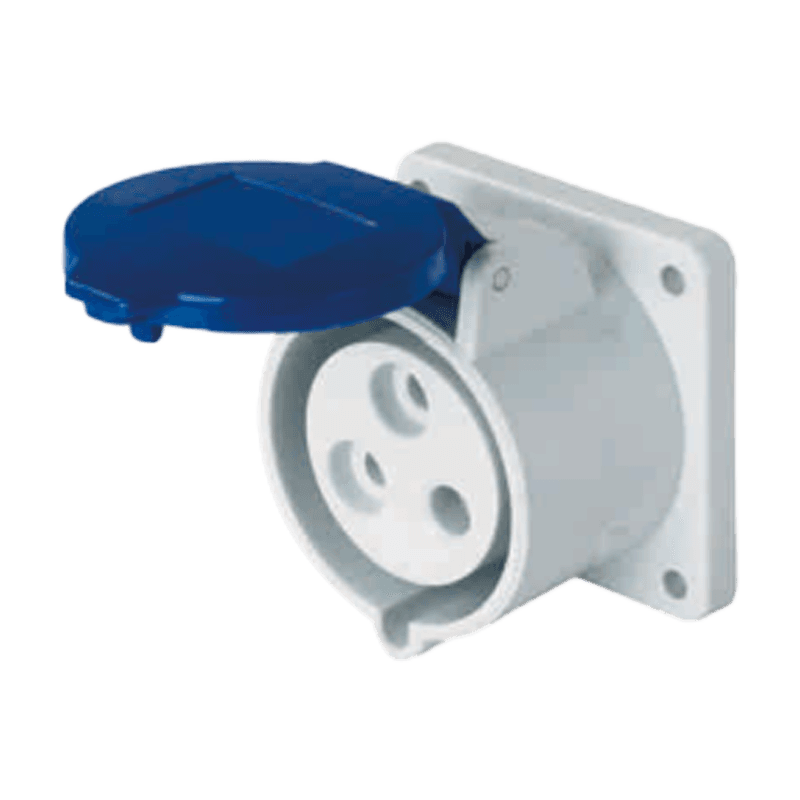 IP44 CEE 16A 6H Three-Pin Wall SocketA yellow three-pin 16A industrial wall socket rated for 230V single-phase supplies, built for durable, water-resistant termination in workshops and industrial environments.View Product →
What Can You Actually Run on a 16 A Socket? Real Application Scenarios
The theoretical maximum is 3,680 W at 230 V, but actual equipment draws different amounts of current depending on duty cycle, starting behaviour, and power factor. The cards below summarise common applications and the practical margins a planner should leave.
Ovens and hobs
2.0–3.5 kW. A 3.5 kW oven on a dedicated 16 A circuit works, provided the cable is 2.5 mm² and no other high-load device shares the circuit. Check the connection terminals, because oven elements draw current for long periods and loose terminals create heat.
Water heaters
3.0–3.5 kW. Tankless point-of-use heaters and electric showers are classic 16 A applications. The load sits close to the continuous limit, so the socket must receive a dedicated feed and should not be shared with other sockets or lighting circuits.
Portable EV chargers
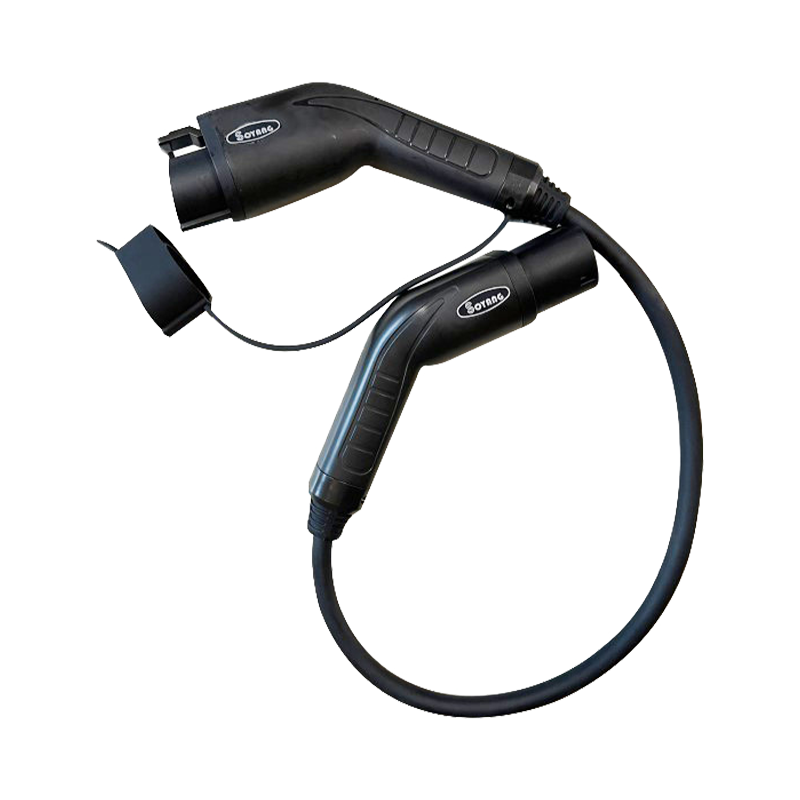
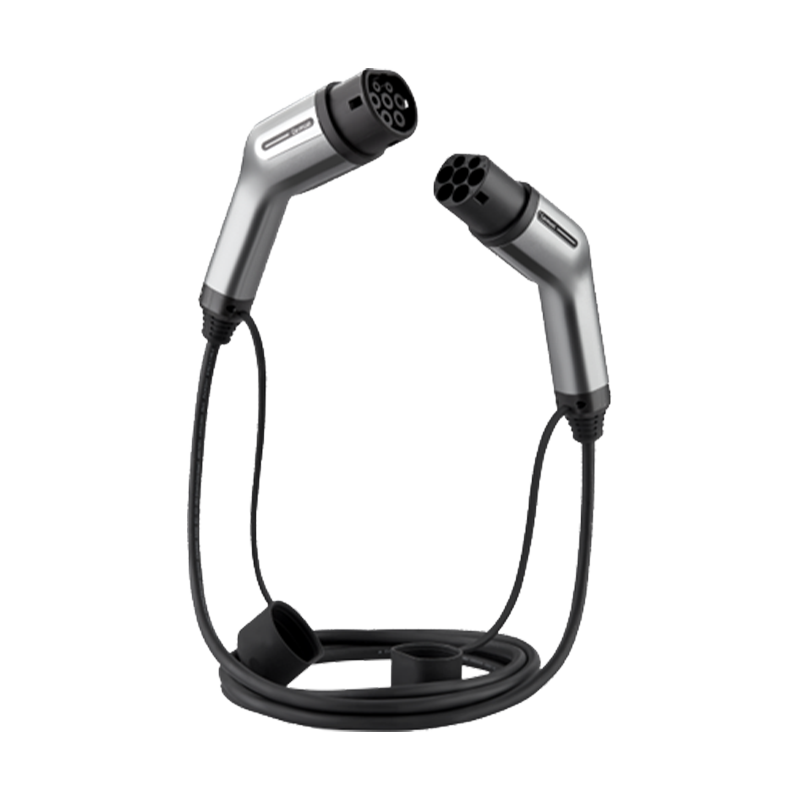
2.3–3.6 kW. Mode 2 charging cables with Schuko plugs often draw between 10 A and 16 A. Charging runs for many hours, so the socket and its wiring need to be in good condition and preferably protected on their own circuit.
Motors and machine tools
A 2.2 kW motor running at 10 A can draw 50 A or more during startup for a fraction of a second. The socket usually survives this inrush, but the circuit breaker must be a type that does not trip on the momentary spike.
Heat guns and welders
1.5–2.5 kW with intermittent duty. Because these tools are not continuously loaded, the average heat in the socket stays low. Still, use a 16 A rated socket and verify that the plug type matches the machine connector.
Multiple devices on one circuit
Adding currents, not wattages, is the safe method. A 2,000 W heater, a 1,200 W kettle, and a 600 W toaster on a shared 16 A circuit total roughly 16.5 A at 230 V, which exceeds the socket rating. One more appliance will trip the breaker.
If the intended equipment draws more than about 3.4 kW on a 230 V supply, the correct answer is normally a 32 A connection or a dedicated fixed connection rather than a 16 A socket with an adapter.
Power Factor, Inrush Current, and Loads That Break the Simple Formula
The formula P = U × I assumes a purely resistive load. Many real devices are not purely resistive. Motors, transformers, welding inverters, and LED drivers draw current that is out of phase with the voltage. The result is that the apparent current in the wires is higher than the active power in watts would suggest.
Take a 2.2 kW single-phase motor on a 230 V supply with a power factor of 0.8 and an efficiency of 0.85. The electrical input is about 2.6 kW, and the current is about 14 A. In practice, the full-load current of such a motor is often close to the 16 A limit even though the mechanical output is only 2.2 kW. A socket rated 16 A is working near its current limit, not near its wattage limit. Reactive current heats conductors and contacts exactly like active current. For planning purposes, the current on the nameplate, not the watts, is the value that must be compared with the socket rating.
Starting Current: The Hidden Peak
Induction motors can draw five to seven times their running current during the first cycles of starting. A table saw with a running current of 9 A can briefly pull more than 50 A. New, high-quality socket contacts can tolerate this hundreds of times without damage. A worn or corroded socket, however, begins to heat in the contact area during every startup, and over months the heat accelerates oxidation, increasing resistance further. This is a common root cause of burned 16 A sockets on workshop equipment.
When selecting protection for such a circuit, choose a miniature circuit breaker with a type C or type D trip characteristic if nuisance tripping occurs, and keep the wiring short and tight so the voltage drop during the inrush remains acceptable.
Circuit Protection: Matching the 16 A Socket with the Right Breaker
A 16 A socket is only as safe as the upstream protection. The breaker has two jobs: protect the cable from overload and short circuit, and allow enough current for normal operation without nuisance trips.
| Socket rating | Nominal power at 230 V | Recommended breaker | Typical conductor | Typical use |
|---|---|---|---|---|
| 10 A | 2,300 W | 10 A (B curve) | 1.5 mm² | Lighting circuits, small appliances |
| 13 A | 2,990 W | 13 A fuse (BS 1363) | 1.5–2.5 mm² | UK fused plugs, portable equipment |
| 16 A | 3,680 W | 16 A (B or C curve) | 2.5 mm² | Ovens, heaters, workshop sockets |
| 32 A | 7,360 W | 32 A (B, C, or D curve) | 6 mm² or larger for long runs | Large heaters, welding outlets, industrial kitchens |
Using a breaker larger than the cable rating turns the cable into the weak point. A 20 A breaker protecting a 2.5 mm² cable that is only rated at 18 A under the installed method can allow the cable to overheat before the breaker opens. A 16 A socket is meant to be a defined point in the system; the breaker, cable, and socket must be planned together and checked against the local wiring standard.
How to Judge Whether a 16 A Socket Really Delivers Its Rating
A low-quality socket marked 16 A will run hotter, loosen sooner, and fail earlier than a properly type-tested unit. Since the socket is the last device between a machine and the grid, its quality affects both uptime and safety. Every 16 A socket on your installation carries markings that tell a trained eye whether it is safe to trust. The housing should show the rated voltage and current, the IP code, and certification marks from an independent body. CE alone is a self-declaration; marks such as VDE, GS, or ENEC indicate type tests conducted by a recognised laboratory.
What to check when evaluating a socket:
- Markings: voltage, current, IP code, frequency if listed, and certification marks. The IEC 60309 standard is usually printed on the product and the packaging.
- Contact design: the contact springs should press firmly on the plug pins over the full insertion depth. Thin spring steel loses tension after a few hundred operations.
- Housing material: the housing should be self-extinguishing and resistant to UV if used outdoors. Polypropylene and rubber housings behave differently at low temperatures.
- Contact material: phosphor-bronze or brass contacts with appropriate plating provide consistent conductivity and corrosion resistance.
- Test evidence: a genuine manufacturer publishes certificates for temperature rise, endurance, and IP protection. If the supplier cannot produce them, treat that as a warning sign.
Manufacturers that operate their own test facilities generally deliver more consistent assemblies. Zhejiang Shuangyang Group has built 16 A and 32 A CEE plugs, sockets, extension cords, and cable reels since 1986, with an in-house VDE test centre, ISO 9001, ISO 14001, and ISO 18001 certified management systems, and more than 100 QC personnel performing routine inspection before shipment. Those are the kind of signals a buyer should look for when comparing sources. You can browse the complete range of power-distribution products on our site, but the general principle applies beyond any single catalogue: insist on documented test evidence, inspect production samples, and verify the marks on the finished goods.
16 A on a Cable Reel: Derating That Is Easy to Forget
A cable reel is a very convenient way to bring 16 A power into a workshop or outdoor site, but the same reel creates a thermal trap when the cable stays coiled.
When current flows, every strand of the conductor produces heat. In a coiled cable, the heat of the inner turns cannot escape to the surrounding air because each layer of cable acts as insulation. The temperature inside the drum rises well above the temperature of the same cable laid out straight on the ground. A flexible rubber cable rated at 16 A in open air may reach dangerous temperatures when fully wound on a reel and loaded at the same current.
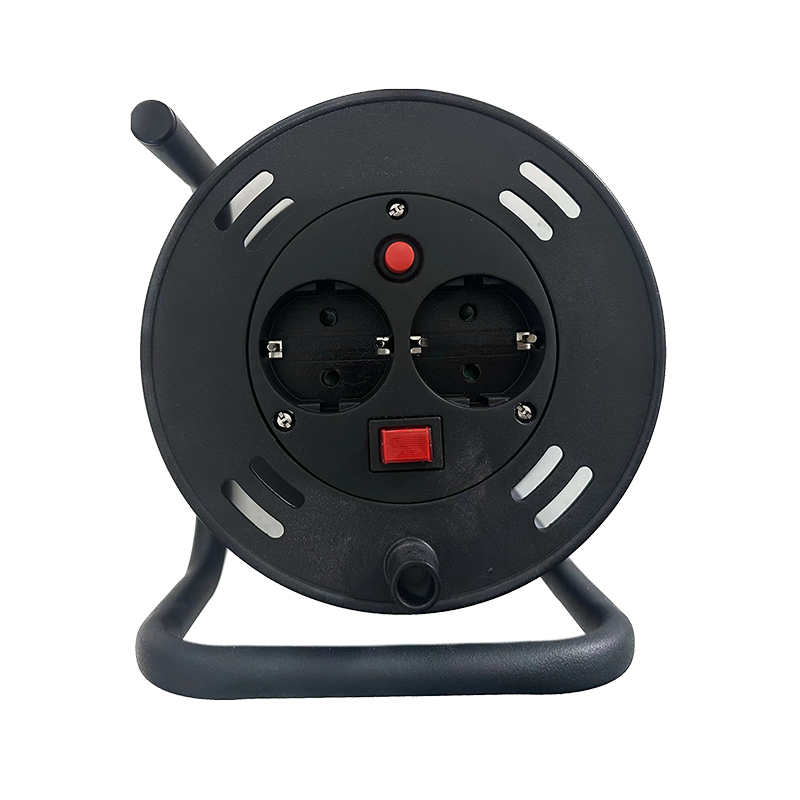
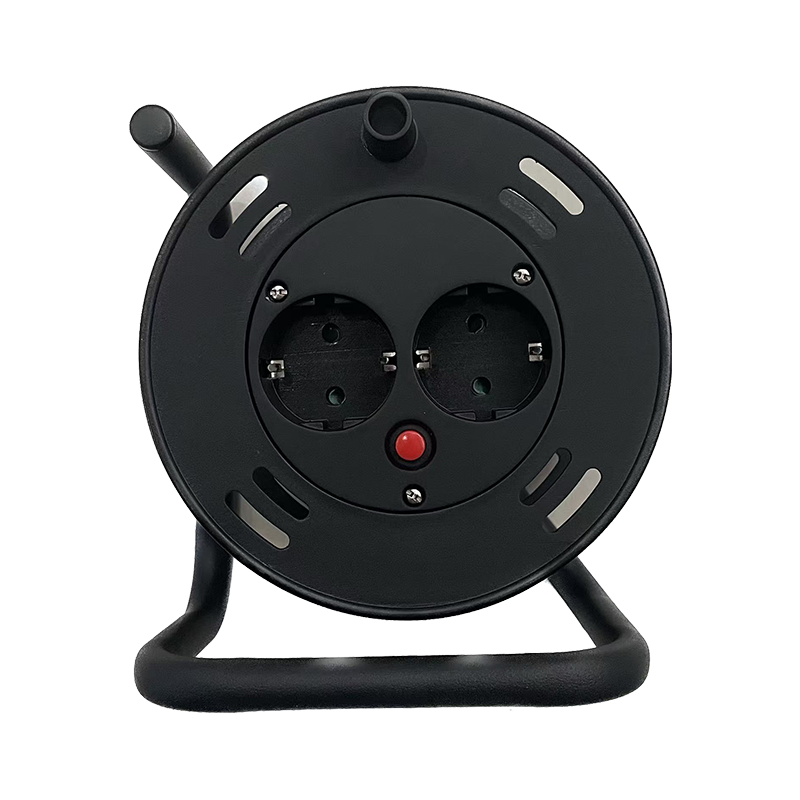
Standard mitigation is to derate the current by 30–50% when the cable remains wound, or to unwind the drum completely for high loads. On a 230 V single-phase 16 A reel, that means keeping the load below roughly 2,000–2,400 W when the cable is coiled. A three-phase 16 A reel on a 400 V supply should be derated in the same way. Many industrial cable reels integrate a thermal overload protector that switches off before the cable insulation is damaged, which is a sensible feature for critical sites.
When planning a workshop supply from a reel, treat the reel as a temporary distribution point, not as a permanent feeder. Unwind the full length for any load above 2,500 W, and inspect the drum inlet and socket outlet for signs of overheating after heavy use.
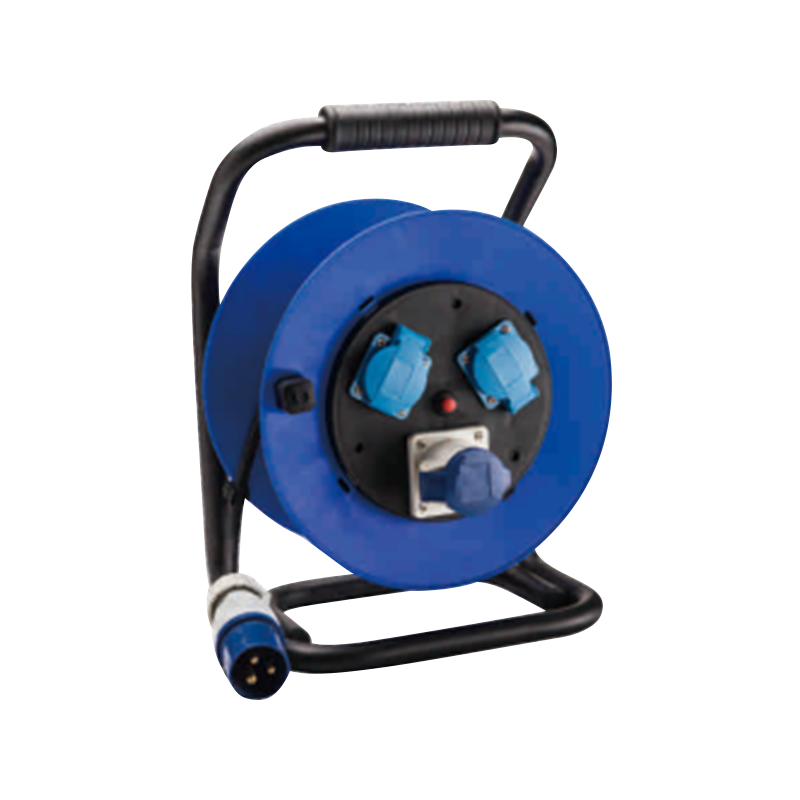 CEE Cable Reel with Three Outlets and 40m H07RN-F CableThis reel provides one CEE 16A socket and two Schuko outlets on a 40m heavy-duty cable, delivering up to 3000W when fully unwound for mobile workshop power distribution.View Product →
Frequently Asked Questions About 16 Amp Sockets
How many watts can a 16 amp socket handle at 230 V?
A 16 A socket at 230 V can supply a maximum of 3,680 W under nominal conditions. For continuous use longer than three hours, keep the load at or below roughly 2,940 W.
Is a 16 A socket the same as a 3,500 W socket?
In practice the two are often used interchangeably, because at the older European 220 V supply the maximum is exactly 3,520 W. On a modern 230 V grid the nominal capacity is 3,680 W. Both values appear in datasheets and product descriptions, so check which voltage the manufacturer assumed.
Can I plug a 10 A device into a 16 A socket?
Yes, it is electrically safe because the device draws less current than the socket rating. The opposite direction is risky: a 16 A device plugged into a 10 A socket can overheat the socket and its wiring. Always check the plug type and the current draw before using an adapter.
How many watts is a three-phase 16 A socket?
For a 400 V three-phase CEE socket with a balanced load and unity power factor, the calculation is √3 × 400 V × 16 A ≈ 11.1 kW. In motor circuits, the usable watts will be lower once power factor and efficiency are applied.
What cable size do I need for a 16 A socket?
Normally 2.5 mm² copper for a 16 A circuit in household and light-industrial installations. For very short connections or specific standard requirements, verify against the local electrical code and the installation method.
Can a 16 A socket be used for EV charging?
Yes, many Mode 2 portable chargers are designed for a 16 A supply. Because charging lasts for hours, treat it as a continuous load. Use a dedicated 16 A socket with 2.5 mm² wiring and avoid sharing the circuit with other high-power devices.
What is the difference between a 16 A and a 32 A CEE socket?
The 32 A socket has larger pins and a wider body to carry higher current. Both use the same IEC 60309 system of voltage colour coding, but the pin diameter differs, so a 16 A plug cannot physically enter a 32 A socket and vice versa. A 32 A socket at 230 V handles 7,360 W nominal.
Can I plug a 16 A industrial plug into a 16 A household socket with an adapter?
Not safely. A CEE 16 A plug requires a CEE socket with a spring-loaded shutter and proper keying. Household adapters for this combination are not standardised and bypass the protection that makes the industrial system reliable. Install the matching socket instead.
A Short Field Checklist Before You Connect a 16 A Socket
Instead of memorising a single wattage figure, run through these checks on site before connecting a high-power load.
- Confirm the actual supply voltage with a multimeter before calculating watts.
- Check the wiring cross-section and the upstream protection. A 16 A circuit means 2.5 mm² minimum and a correctly rated breaker.
- Add up every load on the same circuit. Amperes, not watts, are the safe common denominator when comparing multiple devices.
- For continuous loads over three hours, derate to about 80% of the nominal current, which is 12.8 A and roughly 2,940 W at 230 V.
- Keep cable reels unwound for high loads, or use a reel with a thermal cut-out.
- Verify that plugs and sockets carry the same current, voltage, and IP rating, and that the CEE keyway and colour match the supply.
- Inspect sockets for heat discolouration, loose contacts, and mechanical damage before every heavy use.
If you are specifying products for a workshop or an export project, the safest path is to order tested assemblies rather than loose components. A manufacturer that can provide certified plug-socket-cable combinations removes the risk of mismatched ratings at the point of installation and gives your team one less variable to worry about when a machine is waiting to start.