

 Language
 русский
 中文简体
 Español


How to Choose the Right Industrial Plug Amperage and Pin Configuration
A maintenance supervisor on a food-processing line ordered a 32A three-phase plug for a pump motor and only found out at changeover that the existing socket was a 16A red five-pin unit. The plug would not even reach the locking collar, because 16A and 32A pins have different diameters, and the sleeve spacing is deliberately different. The line stayed down for two hours while the correct socket was sourced from another plant.
Industrial plugs and sockets are not a one-size-fits-all decision. Amperage and pin configuration are the two defining parameters, and they must be decided together, before you compare brands, colors or IP ratings.
- Amperage defines how much continuous current the connector can pass without the contact temperature exceeding the limit set in the IEC 60309 standard. Choose it from the equipment's full-load current, never from the socket that happens to be free.
- Pin configuration defines which conductors are connected, meaning phase, neutral and protective earth. It must match both the supply system and the internal wiring of the equipment.
The short answer is this: calculate the full-load current, add a 20-25 percent continuous-operation margin, then select the pin arrangement from the phase, neutral and earthing requirement of the machine. The sections below explain why that sequence works, how to read the markings on a connector, and which mistakes cause the most field failures.
Step 1: Choose the amperage from the load, not from the socket
The amperage rating of an industrial plug is the maximum current it can carry continuously while the temperature of the contacts stays within the limits defined by IEC 60309. The rating is built into the physical design of the connector: pin diameter, contact sleeve length, spring pressure and the cross-section of the internal terminations.
Choose the plug by measuring the full-load current of the equipment under real working conditions, not by the value on the motor rating plate alone, because pumps, compressors and welders all draw more current under load. Then select a plug rated at least 20-25 percent above that operating current.
Why a 20-percent margin protects the connection
When a connector runs at 100 percent of its rating continuously, the contact resistance produces heat at the interface between pin and sleeve. That heat accelerates the loss of spring pressure, which increases resistance further, which raises temperature again, and the connection slowly degrades. A modest margin keeps the contact temperature well below the threshold where copper oxidizes, plastic creeps and terminal screws loosen.
The margin also absorbs real-world variations such as supply voltage imbalance, harmonic currents from variable-speed drives, and higher ambient temperatures inside enclosures. A 16A plug feeding a load that draws 13-14A continuously is acceptable; a 16A plug feeding a load that draws 15.5A every shift is a failure waiting to happen.
Typical full-load current ranges for common industrial equipment
16A, 32A, 63A and 125A: what each rating can actually supply
IEC 60309 connectors are standardized at 16A, 32A, 63A and 125A. The pin diameter changes with the amperage, which physically prevents a 32A plug from entering a 16A socket. A 16A pin measures 5mm in diameter, a 32A pin 6mm, a 63A pin 8mm and a 125A pin 10mm. This is a safety feature, not an inconvenience: it stops someone from overloading a small socket by forcing in a larger plug.
| Amp rating | Pin diameter | Max single-phase load (230V) | Max three-phase load (400V) | Typical equipment |
|---|---|---|---|---|
| 16A | 5mm | 3.7kW | 11.1kW | Small pumps, light towers, power tools, single-phase chargers |
| 32A | 6mm | 7.4kW | 22.2kW | Compressors, welders, generator sets, small distribution boards |
| 63A | 8mm | 14.5kW | 43.6kW | Large pump sets, event power, site distribution panels |
| 125A | 10mm | 28.8kW | 86.6kW | Containerized power, temporary mains, heavy plant connections |
The power values in the table are based on ideal conditions. If the cable run is long, if the ambient temperature is above 30 degrees or if the equipment is enclosed without airflow, the usable capacity drops further. In those cases, moving up one amperage class is a low-cost way to reduce the risk of overheating.
16A: portable and light duty
Use for tools, lighting towers, single-phase pumps, small compressors and charging cables. The 16A class covers most temporary power needs on construction and maintenance sites.
32A: machine electrics
Use for three-phase motors above 5.5kW, welding sets, generators and small distribution boards. 32A is the most common rating for permanent machine connections inside factories.
63A and above: power distribution
Use for site feeders, large pumps, event power and temporary mains where multiple loads are supplied from one point. These connectors are heavier and require thicker cable entries.
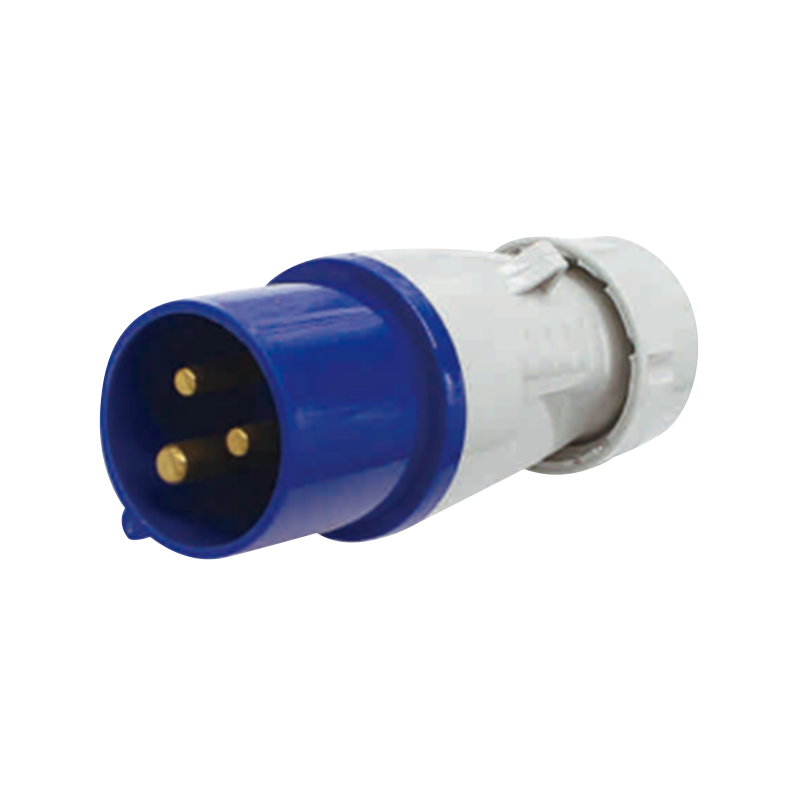 GP51 CEE 16A 6H 3-Pin Industrial PlugThis three-pin plug matches the 2P+E configuration described above, supporting single-phase power at 200-250V with IP44 protection for industrial connections.View Product →
Step 2: Choose the pin configuration from the supply system
Pin configuration means the number and arrangement of contact pins, which corresponds directly to how many conductors the system needs. In IEC 60309 terminology, the configuration is written as 2P+E, 3P+E or 3P+N+E. The letter P stands for phase conductors, N for the neutral conductor and E for the protective earth conductor. The total number of pins is the sum, so 2P+E is a three-pin plug, 3P+E is a four-pin plug and 3P+N+E is a five-pin plug.
The decision rule is simple: count the conductors the equipment actually needs. A single-phase 230V pump needs one phase, one neutral and one earth, so it gets a three-pin plug. A three-phase motor that only needs phases and earth gets a four-pin plug. A three-phase distribution panel that feeds single-phase circuits from each phase needs neutral as well, so it gets a five-pin plug.
| Pin count | Designation | Conductors | Supply system | When to use |
|---|---|---|---|---|
| 3-pin | 2P+E | Phase, neutral, earth | Single-phase 200-250V | Single-phase pumps, heaters, power tools, EV chargers, lighting |
| 4-pin | 3P+E | Three phases, earth | Three-phase without neutral | Three-phase motors, heating elements, ventilation units that need no neutral |
| 5-pin | 3P+N+E | Three phases, neutral, earth | Three-phase with neutral | Equipment with control circuits, mixed three-phase and single-phase loads, distribution boards |
Three-pin plugs: single-phase loads
The three-pin configuration is the industrial version of a domestic plug. It carries one phase, one neutral and one protective earth, and is most commonly seen in blue 230V connectors with the keyway at the 6 o'clock position. The earth pin is longer than the phase and neutral pins, so it makes contact first when the plug is inserted and breaks last when it is withdrawn. This make-first-break-last sequence guarantees that the protective earth is always connected before live power reaches the equipment.
Four-pin plugs: three-phase without neutral
The four-pin configuration connects three phases plus protective earth. It is used where the load is genuinely three-phase and has no single-phase components that need a neutral, such as induction motors, resistive heaters in drying ovens, and older welding transformers. Selecting a four-pin plug saves one conductor, but only when the equipment truly does not need neutral. If a control transformer, solenoid or indicator lamp inside the machine requires neutral, the correct choice is five pins.
Five-pin plugs: three-phase with neutral
The five-pin configuration is the most flexible. It carries three phases, neutral and earth, and is used for distribution boards, generators feeding mixed loads, and machines with control circuits that need a 230V neutral reference. Many plants standardize on five-pin connectors everywhere because one socket type covers both three-phase motors and single-phase control supplies. The practical cost is one extra conductor in the cable and a slightly larger plug body.
Conductor count comparison: 3-pin, 4-pin and 5-pin connectors
Question 1
Is the equipment single-phase or three-phase? Single-phase means one phase conductor, three-phase means three phase conductors.
Question 2
Does the equipment need a neutral conductor for control circuits, sensors or single-phase internal loads?
Question 3
Select 3-pin for single-phase, 4-pin for pure three-phase without neutral, and 5-pin for three-phase with neutral.
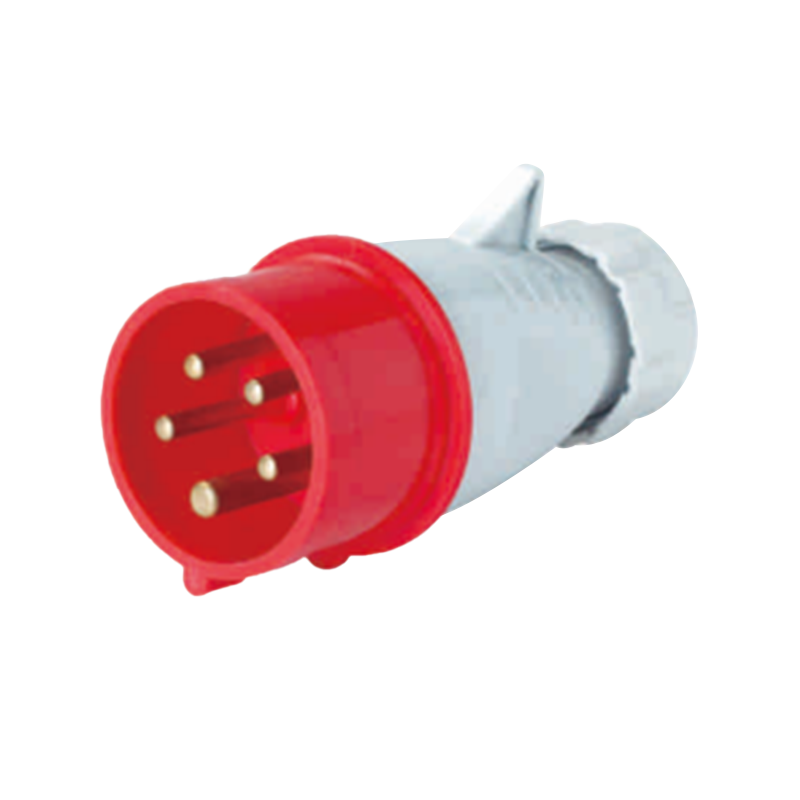 GP55-2 CEE 16A 6H 5-Pin Industrial PlugWith a 3P+N+E pin arrangement, this five-pin plug suits three-phase systems with neutral, rated at 240/415V and protected against dust and water.View Product →
Step 3: Verify the voltage keyway and color code
Amperage and pin count alone are not enough to specify a connector. The same 16A three-pin plug body is available for 110V and 230V systems, and the same 16A five-pin body is available for 220V and 400V three-phase systems. IEC 60309 prevents mismatching with a mechanical keyway, also called a clock-hour position, and a housing color that signals the voltage range.
A raised key on the plug and a matching keyway in the socket collar allow the plug to enter only a socket with the same voltage class. If the keyway does not align, the plug simply will not insert. Additional safety comes from the color of the housing, which is fixed by the standard.
| Housing color | Voltage range | Keyway position | Typical system | Common applications |
|---|---|---|---|---|
| Yellow | 100-130V | 2 o'clock | 110/120V single-phase | Construction site transformers, US export equipment, boat supply |
| Blue | 200-250V | 6 o'clock | 230V single-phase | Standard factory lighting, pumps, heaters, chargers |
| Red | 380-480V | 9 o'clock | 400V three-phase | Motors, compressors, site distribution, generators |
The label on every certified connector shows a combination such as "16A, 6h, 220-250V, 2P+E". Reading this is a reliable way to confirm what you are ordering: 16A tells the amperage, 6h tells the keyway position, 220-250V tells the voltage class, and 2P+E tells the pin configuration. If the label is missing, treat the connector as unverified and have it tested.
Buyers sometimes assume that a blue connector and a red connector with the same number of pins are interchangeable because both carry three-phase current. They are not. A three-phase motor designed for 230V between phases runs on a blue three-phase supply in markets that use 230V three-phase distribution, while a motor designed for 400V needs the red connector. The keyway keeps them apart, but only if the specifier ordered the correct color and hour position in the first place.
Step 4: Set the protection rating to the environment
The electrical specification is meaningless if the connector cannot survive its surroundings. The Ingress Protection rating, or IP rating, defines how well the connector resists solid particles and water. Industrial plugs and sockets are commonly specified at IP44, IP54, IP55 and IP67 depending on whether they live indoors, outdoors, in dusty halls or in washdown areas.
| IP rating | Definition | Where it fits | Typical applications |
|---|---|---|---|
| IP44 | Protected against tools larger than 1mm and splashing water | Dry indoor areas with light splash exposure | Workshop sockets, indoor cable reels, light production areas |
| IP54 | Protected against limited dust ingress and splashing water | Dusty or damp indoor environments | Warehouses, grinding areas, covered outdoor storage |
| IP55 | Protected against limited dust and low-pressure water jets | Outdoor areas exposed to rain and hose washdown | Outdoor power distribution, construction sites, farm buildings |
| IP67 | Dust-tight and protected against temporary immersion in water | Wet areas, high-pressure washdown, flooded zones | Food processing, marine applications, event power outdoors |
The enclosure material matters as much as the IP number. Polypropylene housings are rigid, economical and fine for most indoor applications. Rubber or chlorinated rubber housings absorb impact better, resist chemicals and hold the seal more reliably in cold weather. A rubber-bodied plug with a screw-locking collar is the safer choice when the connection is unplugged and re-plugged frequently on wet ground.
Humidity and temperature affect connector life more than most buyers expect. High humidity promotes surface tracking across the insulation between pins, and temperature swings create condensation inside the housing that corrodes the contact surfaces. If the plug lives on a dock, in a refrigerated warehouse or beside a steam line, choose a higher IP class and inspect the seals during routine maintenance.
What to check with the manufacturer before ordering
Once the amperage, pin count, voltage keyway and IP rating are clear, the remaining risk is quality consistency across production batches. Industrial plugs and sockets carry the weight of electrical safety, and the documentation behind them matters more than the price difference between suppliers.
- Certification and standards: For Europe, look for products tested and certified to IEC 60309, carrying marks such as VDE, GS or a recognized national certification body. For North American destinations, verify the corresponding UL or ETL listing for the specific voltage and configuration.
- Test reports: Ask for type-test evidence covering temperature rise at rated current, dielectric strength, insulation resistance and mechanical endurance. A serious factory can provide the test report together with the CE declaration of conformity.
- Material quality: Check the contact material, usually brass or copper alloy for the pins and sleeves, and whether the terminals accept the intended conductor size. Tin-plated contacts improve corrosion resistance in humid environments.
- In-house quality control: A manufacturer with its own testing equipment and a structured inspection process will catch dimensional deviations, insufficient spring pressure and defective seals before shipment. Confirming that the supplier has its own test center is often more valuable than any brochure claim.
Because this factory operates its own VDE test center and more than one hundred quality control personnel across the production lines, we can ship every industrial plug and socket with test records that trace back to each batch. Buyers who need custom cable lengths, different terminal sizes or special keyway configurations receive the same electrical testing as the standard range, which reduces the failure rate in their own distribution chain.
After commissioning, a scheduled inspection program keeps connections reliable regardless of the initial quality. Regular checks for loose terminals, damaged seals, bent pins and melted housings can be found in the maintenance guide for industrial sockets, which covers the inspection intervals and the points that fail first in normal service.
Common mistakes when selecting industrial plugs
Most field failures trace back to a small set of predictable errors. Reviewing them before placing an order eliminates the majority of mismatched-connector problems.
- Choosing the plug by cable size instead of load current. A thick cable can still feed an overloaded connection if the plug rating is lower than the equipment demand.
- Using a 4-pin plug where neutral is actually needed. Some machines have three-phase motors plus 230V control circuits that require neutral, so the connector must be 5-pin.
- Forcing a plug into a socket of a different voltage class. The keyway exists to stop this, but forcing a plug or modifying the keyway is a serious safety violation and voids the approval.
- Ignoring the difference between 16A and 32A pin geometry. A 32A plug cannot supply a 16A socket, and a 16A plug inserted into an oversized socket can have poor contact pressure and overheat.
- Selecting IP44 for a washdown area. Water jets directed at the seal face can penetrate an IP44 joint after repeated cleaning cycles; IP55 or IP67 is required.
- Reusing a damaged plug body after mechanical impact. Hairline cracks in the housing or collar break the seal and allow water to reach live contacts, even when the connector still clicks into place.
Frequently asked questions
What amperage plug do I need for a 7.5kW three-phase motor?
A 7.5kW motor at 400V typically draws around 14A at full load. Under continuous operation, a 16A plug would run close to its limit, so the conservative and standard choice is a 32A plug or socket, which provides headroom for starting current, supply voltage variation and rising contact temperature over years of service.
How do I choose between a 4-pin and a 5-pin industrial plug?
Use a 4-pin plug when the equipment is a pure three-phase load such as a motor or heater with no neutral connection. Use a 5-pin plug when the equipment has control circuits, instrumentation, sockets or any component that needs a neutral conductor, or when the plug feeds a distribution board with mixed loads.
Why will a 32A plug not fit into a 16A socket?
The pin diameter and the distance between pins are defined differently for each amperage class. A 16A pin is 5mm in diameter, while a 32A pin is 6mm. This physical difference prevents an oversized plug from being connected to an undersized socket and avoids overloading a circuit that cannot supply the current.
Can a blue 230V plug be used in a red 400V socket?
No. The keyway position differs between voltage classes, so the plug will not enter the socket. A blue connector has the keyway at the 6 o'clock position, while a red 400V connector has the keyway at the 9 o'clock position. The color and keyway are compulsory safety features, and modifying either one is not permitted.
Does IP67 mean the connector can be left underwater permanently?
IP67 means temporary immersion to a depth of up to one meter for 30 minutes. It is suitable for heavy rain, flooded floors and incidental submersion, but not for permanent underwater service. For continuous immersion, a higher classification or a purpose-built underwater connector is required.
A practical ordering checklist
Confirm each point before sending the specification to your supplier
- Supply voltage and frequency at the installation point, for example 230V or 400V, 50Hz or 60Hz.
- Full-load current of the equipment under actual working conditions, then add 20-25 percent margin.
- Number of conductors: phase, neutral and earth, which sets the pin count at 3-pin, 4-pin or 5-pin.
- Voltage class and keyway position, confirmed by the color code and the 6h or 9h label.
- IP rating based on the environment, with higher protection for outdoor, washdown or dusty areas.
- Cable entry size and terminal compatibility with the conductor cross-section.
- Certification marks required for the destination market, including VDE, GS, CE or UL/ETL as applicable.
- Physical form: straight plug, angled plug, panel socket, wall socket or cable connector, matching how the equipment is positioned and connected.
Correctly specified industrial plugs and sockets are invisible in daily operation. They connect first time, stay cool under load, keep water out and last for years with nothing more than a periodic check. The short time invested in verifying amperage and pin configuration at the ordering stage pays back in avoided downtime, reduced spare-part stock and a measurably lower failure rate across every powered asset.