

 Language
 русский
 中文简体
 Español


How to Connect an Industrial Socket Safely: CEE Wiring Steps for 16A & 32A
Open a typical 16 A CEE industrial socket and you will find the same few parts every time: a housing stamped with an IP rating, a cable gland, screw terminals marked L, N and PE, a strain-relief clamp, and an hour figure such as 6h cast beside the keyway. Connecting the socket correctly is a matching exercise built around those parts. Match the amperage and pin count to the circuit, match the clock position to the voltage, match the cable cross-section to the load and the run length, then terminate at the right torque and test before switching on. Do those five things and the connection will run cool for years; skip one and the usual symptoms follow quickly — warm pins, nuisance RCD tripping, or a failed inspection.
This guide walks through the two jobs people actually ask about: wiring a 16 A 230 V single-phase wall socket and wiring a 5-pin 400 V three-phase socket. It then covers cable sizing with worked voltage-drop figures, mounting height and location, the tests to complete before energizing, and the wiring faults most often traced back to the field from factory test benches. All of it assumes IEC 60309 hardware — the plug and socket system known as CEE, which covers the majority of industrial connections across Europe and the export markets supplied from the Ningbo and Zhejiang manufacturing region.
What Does Connecting an Industrial Socket Involve?
In short: isolate and lock off, identify the supply, pick the right socket variant, land the conductors, seal the gland, and test. The screwdriver work takes about twenty minutes on a wall socket; the decisions around it — rating, poles, clock position, cable, torque — are what separate an installation that passes first time from one that calls you back within a month.
Match the circuit
A 16 A socket on a 2.5 mm² feed serves most portable tools and small machines. Welders, compressors and kilns usually justify 32 A, which means larger terminals, an M25-class gland and 4–6 mm² cable.
Match the voltage keyway
The clock position rotates the keyway so a 230 V plug cannot enter a 110 V socket of the same amperage. 6h is the everyday position for 230 V single-phase and 400 V three-phase; 4h belongs to 110 V site supplies.
Match the environment
IP44 handles splashes in a workshop or on a covered site. Wash-down areas, outdoor exposure and dust-heavy halls need higher-rated enclosures, downward-facing gland entries and gasketed lids that are actually closed between uses.
One more choice comes before any wiring: fixed or interlocked. A plain socket must be switched by a separate breaker or switch-disconnector, which leaves room for human error. An interlocked socket mechanically blocks insertion and withdrawal under load and switches the supply internally — worth the small price difference wherever operators plug and unplug daily. None of these choices change the terminal wiring, but they decide how forgiving the finished installation will be.
Read the Socket Before You Wire It: Pins, Clock Positions and Ratings
Industrial sockets carry more information on the housing than domestic ones, and every mark is a wiring instruction. Three of them matter most.
What the pin count tells you
Three pins (2P+E) mean single phase: line, neutral and protective earth. Four pins (3P+E) mean three phases and earth with no neutral — enough for balanced motor loads such as saws, pumps and fans. Five pins (3P+N+E) add the neutral, which control circuits, lighting modules and the mixed loads on modern machines need. Check the machine's plug first; the plug tells you the truth about what the equipment expects, regardless of what is already on the wall.
What the clock position does
The hour figure — 4h, 6h, 9h — sets the angle of the keyway so that plugs and sockets of different voltages cannot be mated at the same amperage. In practice, 6h covers 200–250 V, which is why both blue 230 V single-phase and red 400 V three-phase hardware carry it; their pin counts differ, so they still cannot cross-mate. 4h is the usual position for 110–130 V single-phase site supplies fed through isolating transformers, and 9h appears on 110–130 V three-phase systems. Colour is only a convention — blue, red and yellow help operators at a glance, but the hour figure is the actual standard.
Amperage, terminals and glands
A 16 A frame accepts roughly 2.5–4 mm² conductors and an M20 or M25 gland; a 32 A frame moves up to 4–10 mm² conductors and an M25 or M32 gland. Buying the smaller frame to save cost and then forcing oversized cable into it is a common, avoidable error — check the terminal capacity printed in the datasheet before ordering anything.
| Configuration | Pins | Clock position | Typical voltage | Typical applications |
|---|---|---|---|---|
| 2P+E | 3 | 6h | 230 V | Single-phase machines, site tools, welders on light duty (blue) |
| 2P+E | 3 | 4h | 110 V | Construction and site supplies fed through isolating transformers (yellow) |
| 3P+E | 4 | 6h | 400 V | Three-phase motors and balanced loads without a neutral (red) |
| 3P+E | 4 | 9h | 110–130 V | Low-voltage three-phase systems on ships and industrial sites |
| 3P+N+E | 5 | 6h | 400 V | Three-phase machines whose control circuits need a neutral (red) |
If you are still choosing hardware, it helps to see the variants side by side; our CEE industrial socket range lists wall, angled and portable versions across the 16 A and 32 A frames.
Which Tools and Materials Do You Need?
Nothing exotic is required, but two items are skipped far too often: a torque driver and an insulation tester. Lay the full kit out before starting, because the sequence below assumes every check can be done the moment it is needed.
- A two-pole voltage tester to prove the circuit dead — never trust a breaker label alone
- VDE-insulated screwdrivers and, ideally, a torque driver for the terminal screws
- Wire strippers and side cutters sharp enough not to nick conductor strands
- Bootlace ferrules and a crimper if you will terminate fine-strand rubber cable
- A low-resistance ohmmeter and a 500 V insulation resistance tester for commissioning checks
- A phase-rotation meter whenever a three-phase socket is on the list
- Cable glands matched to the cable's actual outer diameter, plus any sealing inserts
- A marker or label set for identifying cores inside a 5-core cable
Who may legally connect a fixed industrial socket varies by market. Where regulations require a qualified electrician, treat this guide as preparation for the conversation with them, not a substitute for it.
How to Wire a 16 A 230 V Single-Phase Industrial Socket, Step by Step
The 16 A 6h 3-pin socket is the single most common industrial connection in Europe — the blue socket that feeds site tools, lightly loaded welders and hundreds of workshop machines. Here is the full sequence.
- Isolate and prove dead. Lock off the breaker, then test between all conductor pairs at the point of work with a two-pole tester. Confirm the circuit actually corresponds to the label — swap errors at the distribution board are older than anyone admits.
- Mount the body. Fix the socket to its back box at the chosen height and orientation, with the cable entry positioned so water cannot run toward the gland. Leave enough slack to work comfortably; about 120 mm of free conductor inside the housing is enough.
- Prepare the cable. Cut the outer sheath without touching the inner insulation, remove it cleanly, and strip each conductor to the length moulded on the strip gauge — about 10 mm on most 16 A frames. If the cable is fine-strand rubber, crimp on bootlace ferrules first; bare fine strands under a screw terminal are how hot spots start.
- Land the conductors. Line to L, neutral to N, protective earth to the earth symbol. The markings are cast into the terminal area of every compliant CEE socket. Do not rely on core colours alone — number every core as you go.
- Torque and tug. Tighten each screw to the torque marked on the housing; where none is marked, snug plus a quarter turn with a proper driver is the honest fallback on a 16 A terminal. Then tug each conductor firmly. A conductor that slides out now would have worked loose in service.
- Clamp and seal. Fasten the inner strain clamp onto the sheath, not onto the cores, and tighten the gland until the seal visibly compresses. The IP44 rating on the label only exists if the gland and gasket are actually doing their jobs.
- Close and inspect. Seat the gasket, close the lid, and check that the hinged cap covers the outlets fully whenever no plug is inserted.
- Test before energizing. Run the commissioning checks listed further below — continuity, insulation resistance, polarity — then switch on and measure 230 V between L and N and between L and PE, with roughly 0 V between N and PE.
A 32 A socket follows the same order with three differences: bigger terminals that deserve a torque driver rather than feel alone, a larger gland, and correspondingly heavier cable. Forcing 6 mm² conductors into a 16 A terminal designed for a 4 mm² maximum is a rejected inspection waiting to happen.
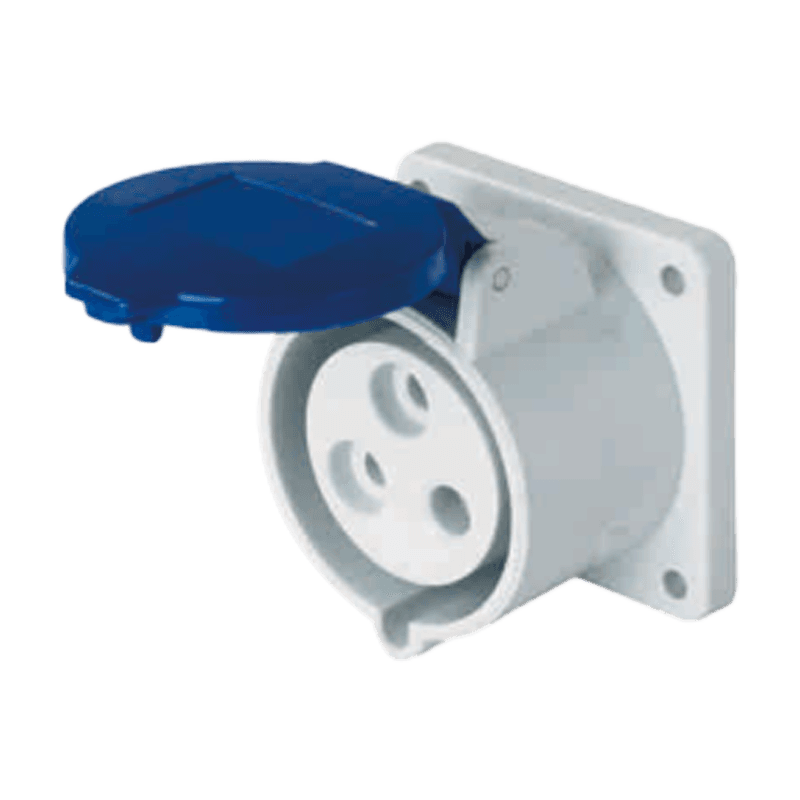 EZ51 CEE 16A 6H 3-Pin IP44 Industrial Wall SocketThis IP44-rated 16 A three-pin CEE wall socket suits the discussion of industrial socket installation and wiring, offering durable, waterproof power access for machines and workshop equipment.View Product →
How to Wire a 5-Pin 400 V Three-Phase Industrial Socket
Choose a 5-pin (3P+N+E) socket whenever the machine needs a neutral — anything with control electronics, 230 V auxiliary circuits, or mixed single- and three-phase loads. A 4-pin socket is fine for purely balanced motor loads, but the 5-pin version is the safer default on new installations because it leaves the neutral available from day one.
- Isolate on all poles. Three-phase circuits need a multi-pole lockoff, and the tester must confirm all three phases are dead. Stored charge in motor windings and drives deserves the same respect as the supply itself.
- Plan the cores. Bring in 5-core cable — 5G2.5 for a 16 A feed, 5G4 or larger for 32 A — and identify every core before stripping. Numbered cores beat colour guessing, especially where two cable standards meet in one panel.
- Strip and ferrule. Same discipline as single phase: sheath cut clean, inner insulation un-nicked, strip length to the gauge, ferrules crimped on fine strands.
- Land the phases, neutral and earth on the marked terminals — L1, L2, L3, N and the earth symbol, sometimes numbered 1 to 3 instead. The one swap that matters most is N against a phase: it puts 400 V across anything designed for 230 V. Check it twice.
- Torque every terminal. Five terminals mean five chances for a loose joint; a torque driver removes the guesswork, and the tug test removes the hope.
- Seal and close as before — inner clamp on the sheath, gland compressed, gasket seated.
- Test: insulation resistance between every conductor pair and to earth, then a phase-rotation check. If the motor runs backward on first start, swapping any two phase conductors at the socket corrects the rotation — that is a commissioning step, not a defect.
Rotation matters more than people expect. A reversed cooling fan can spin quietly in the wrong direction for months; a reversed pump can destroy a mechanical seal in minutes. A rotation meter costs less than either repair.
Site realities also differ — a fixed wall box, a mobile distribution board and a generator feed each impose their own routing and protection choices, which is why we keep a separate guide to the wiring methods for multi-pole industrial sockets.
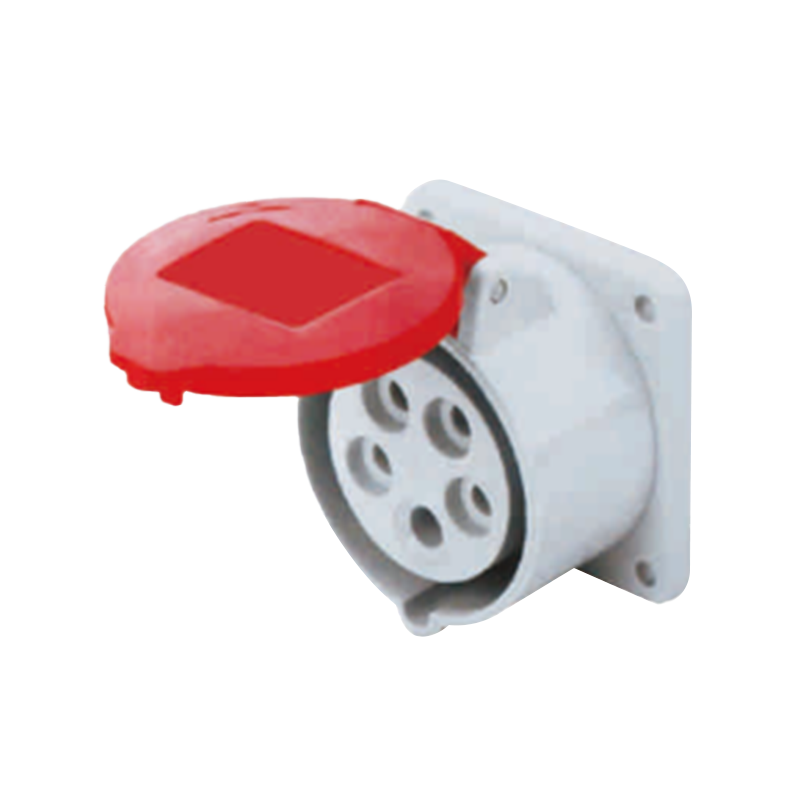 EZ56-2 CEE 16A 6H 5-Pin IP44 Wall SocketAs the article explains, a five-pin socket providing neutral is the safer default for machines with control electronics or mixed loads, making this 16 A 5-pin CEE wall socket a fitting choice here.View Product →
Which Cable Should Feed an Industrial Socket?
Two decisions define the cable: cross-section and sheath. Get the cross-section from current and distance, not from habit — at workshop distances the differences are not subtle.
Voltage drop grows with length, and a socket that measures a full 230 V at the distribution board can be sitting near 219 V at the end of a 50 m run. Induction motors respond by drawing more current and running hotter, which shortens their life even though nothing visibly fails. Keep the total drop within about 3–5%, and budget for the far end of the run, not the near end.
Estimated voltage drop against cable length — 16 A load, 230 V, copper, two-conductor loop
Values assume copper at 20 °C and a steady 16 A load; operating temperature and terminal resistance push real installations a few percent higher. Keep the total drop within roughly 3–5%.
The same logic compresses into a quick sizing rule for common frame sizes on a typical 30 m feed:
Rule-of-thumb minimum copper cross-section for a 30 m feed, drop held near 3%
Assumes a 30 m run and continuous-rated current; longer runs, warm routes and motor loads deserve the next size up, and local wiring rules always take precedence.
Sheath choice is simpler. PVC flexible cord such as H05VV-F belongs indoors, fixed and light-duty. Rubber-sheathed cable — H07RN-F with its neoprene jacket — is the industrial default: it tolerates water, oil contact, abrasion, sunlight and cold far better, and its fine-stranded class 5 conductors are more forgiving of the flexing that comes with portable equipment. The trade-off is that fine strands call for ferrules at every terminal.
One more figure worth knowing: a cable reel with the cable still wound on the drum cannot dissipate heat the way an uncoiled run can. Continuous high loads on a partly wound reel run measurably hotter — the reason manufacturers derate them and the reason quality reels carry thermal cut-outs.
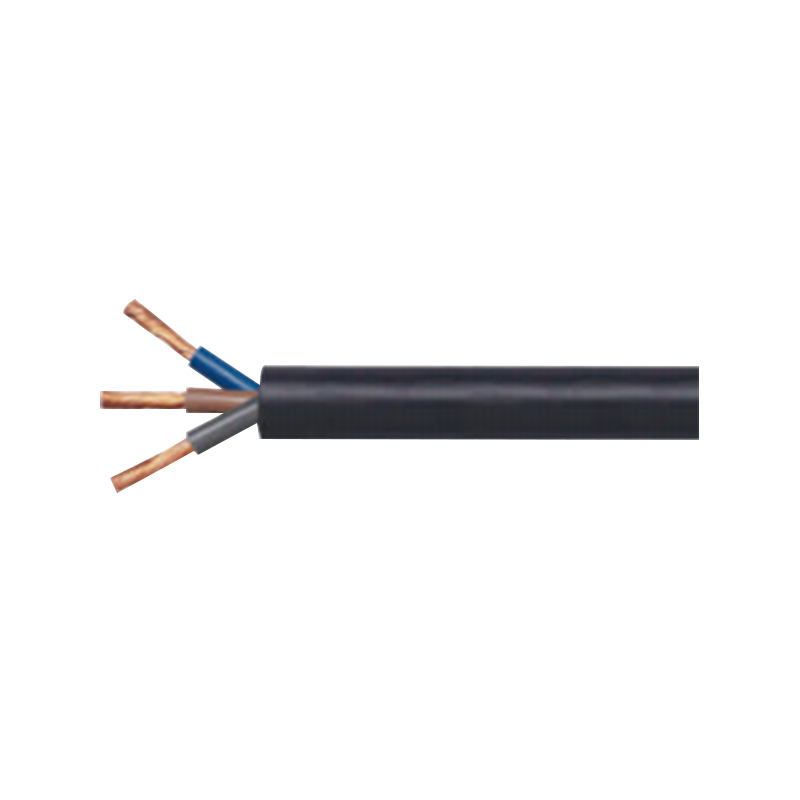 H07RN-F 3G 1.5mm² Neoprene Rubber Sheathed Flexible CableThe guide stresses selecting cable cross-section and sheath by current and site conditions; this 1.5 mm² rubber-sheathed flexible cable illustrates the durable industrial flex those choices lead to.View Product →
Where and at What Height Should the Socket Be Mounted?
Height is a working dimension, not a cosmetic one. Most workshops land between roughly 0.5 m and 1.4 m from finished floor to the socket's centre: low enough that a heavy plug's weight hangs on the cable rather than levering on the pins, high enough to reach without kneeling. In wash-down areas and on outdoor walls, mount higher with the gland entry facing downward and form a drip loop so water is stopped before it reaches the gland.
Location rules are mostly about the plug, not the socket. Keep sockets out of vehicle routes and door swings, away from heat sources that age the gasket, and clear enough that the plug can be inserted without a fight — a 90-degree angled plug solves many tight corners. Every socket should also be reachable quickly in an emergency; a socket hidden behind a machine fails that test no matter how neat the wiring is.
Finally, match the fixing to the wall. Vibration from compressors and planers works loose unanchored back boxes, and a moving socket works its gland seal loose in turn. The gland is the IP rating; treat everything around it seriously.
Which Tests to Run Before Energizing the Socket
Testing converts "it looks right" into "it is right". Five checks cover virtually all of the risk, and the first four take only minutes.
| Test | Instrument | What a pass looks like |
|---|---|---|
| Protective conductor continuity | Low-resistance ohmmeter | Resistance close to zero, typically well under 1 Ω including test leads |
| Insulation resistance | 500 V DC insulation tester | At least 1 MΩ between every live conductor and earth |
| Polarity and voltages | Two-pole tester or multimeter | 230 V between L and N and between L and PE; near 0 V between N and PE |
| Phase rotation | Rotation meter | Sequence matches what the machine expects before first start |
| RCD function | RCD tester | Trips within 300 ms at the rated residual current |
Each failure tells its own story. Continuity that is close to but not at zero usually means a gland clamp biting paint instead of metal. Insulation resistance below 1 MΩ usually means moisture, a nicked sheath, or a stray strand bridging the terminal area. A missing 230 V between L and PE alongside a healthy L-N reading points to a swapped neutral and earth — the single most common fault found on newly wired sockets.
Photograph the completed readings. They become the baseline for the periodic inspections that keep the installation compliant, and they settle any later dispute about when a fault actually appeared.
Which Wiring Mistakes Cause Most Industrial Socket Failures?
After years of warranty returns and field failure analysis, the same short list of wiring faults accounts for most of them. None are exotic; all are avoidable with the sequence above.
Neutral and earth swapped
The circuit works, the board may even pass, and the RCD trips the first time a real load runs. The N-to-PE voltage check catches it in seconds.
Over-stripped conductors
Exposed copper outside the terminal can track across the housing and, at best, fails the visual inspection. Strip to the gauge, not to habit.
Bare fine strands under screws
Fine-strand rubber cable without ferrules spreads under the screw, leaving a joint that heats, loosens and heats further. Crimp first, always.
Guessed torque
Under-tightened terminals glow; over-tightened ones crush conductors. One calibrated driver solves both failure modes for the whole workshop.
Wrong gland, loose seal
A gland that does not grip the sheath's outer diameter leaves the IP44 label decorative. Match gland to cable and compress the seal.
Forcing the wrong hour position
Filed keyways and forced plugs are more common than anyone admits. They damage contacts and defeat the one interlock that prevents wrong-voltage connections.
Frequently Asked Questions
Can I plug a 16 A plug into a 32 A industrial socket?
No. The pin diameter and keyway differ, and that is deliberate. Where a machine's plug and the wall socket genuinely disagree, the correct fix is a properly rated adapter cord or changing one end — never forcing or modifying either part.
What does the 6h marking actually mean?
It is the clock position of the keyway, standardized in IEC 60309-2. 6h corresponds to 200–250 V supplies at 50/60 Hz, which is why blue 230 V single-phase and red 400 V three-phase hardware both carry it; the different pin counts keep them from cross-mating.
How do I know whether my machine needs a 4-pin or 5-pin socket?
Read the machine's plug and nameplate. If anything inside — controls, lights, contactor coils — needs a neutral, you need 5 pins. When buying for an unknown future load, 5-pin costs little more and removes the constraint entirely.
Is IP44 enough for an outdoor socket?
For rain and splash, yes, provided the lid closes between uses and the gland is properly sealed. For hose-down, wash-down or dust-heavy environments, specify higher-rated equipment instead of hoping IP44 stretches further than it does.
Can I use ordinary PVC flexible cord instead of rubber cable?
Indoors, fixed and light-duty: yes. Anywhere with sunlight, oil, abrasion or repeated flexing: no. H07RN-F rubber-sheathed cable exists precisely for those conditions and terminates just as easily once ferrules are crimped on.
Why does my industrial plug get warm?
Heat at a plug means resistance, and resistance means one of four things: a loose terminal screw, a worn contact spring, an undersized cable, or a load creeping above the rating. Work through that list with the circuit isolated — and replace, rather than reuse, a plug that has already discoloured.
Do industrial sockets need RCD protection?
Hand-held equipment and outdoor supplies should sit on 30 mA RCD protection in most jurisdictions, and many sites extend that to every socket circuit. Fixed three-phase machine feeds may rely on other protection schemes — follow the wiring rules that apply to your market.
How soon should a new installation be re-checked?
Terminal screws relax slightly as copper settles under compression. Re-torque and re-test after the first weeks of service, then fold the socket into your periodic inspection cycle and log the readings each time.
How Industrial Sockets Are Verified Before They Ship
Everything above is easier to get right when the hardware behaves predictably, which is why the factory side of the process matters as much as the installer's side. Zhejiang Shuangyang Group has manufactured plugs, sockets, cable reels and rubber cable in Cixi, Ningbo since 1986, operates under ISO 9001, 14000 and 18000 certified systems, and runs an in-house VDE test center supported by more than a hundred quality-control staff who check production before shipment.
On a typical production batch, the checks include dielectric strength between live parts and earth, insulation resistance, temperature rise at rated current, insertion and withdrawal cycle counts on the contact system, and splash tests that verify the IP44 claim rather than trust it. The details an installer needs — terminal capacity, strip gauge, torque marking, gland sizes — are printed on the housing or listed on the datasheet, and any supplier who cannot produce them quickly is telling you something useful about the product.
If you are specifying sockets for a project, send the machine list and cable schedule to the manufacturer before ordering. Matching the socket variant, gland and cable to the real load takes a few emails at the start and prevents the warm-plug callbacks that cost far more later.