

 Language
 русский
 中文简体
 Español


Industry Cable Reel Buyer's Guide: Construction, Ratings, Safety, Maintenance
An industry cable reel is not a longer extension cord on a drum. It is a power delivery unit engineered for continuous work cycles, repeated winding, and environments where oil, dust, moisture, and rough handling are normal. The practical conclusion that most maintenance teams reach after replacing their first few domestic reels is this: the reel itself must be matched to the load, the cable type, the outlet standard, and the physical conditions of the workplace. When it is, the important safety problems—overheating, voltage drop, cable damage, and contact failure—are designed out rather than discovered on site.
This guide explains the engineering decisions behind industrial cable reels: what the main components actually do, which ratings and protection levels matter, how to choose between cable types, and what maintenance keeps a reel dependable for years. The information is written from a manufacturing perspective, with the practical questions that plant engineers and purchasing teams ask before placing an order.
What an Industry Cable Reel Actually Does
An industrial cable reel does three jobs at the same time. It delivers power to a point that is beyond the reach of a fixed socket, it keeps the supply cable off the floor and away from traffic, and it stores the cable in a controlled way that prevents kinks, sharp bends, and surface abrasion. The third job matters more than it appears. A cable that is looped loosely around a hook or dragged across a concrete floor develops cuts in its sheath; once moisture reaches the conductors, the failure is sudden and potentially dangerous.
The second difference is duty rating. A domestic reel with a PVC cable is designed for occasional loads and relatively clean rooms. An industrial reel is expected to run close to its rated current for hours, to be wound and unwound dozens of times per day, and to survive being bumped by forklifts, sprayed with coolant, and left outdoors overnight. As a result, every component of the industrial reel is heavier: the frame, the cable, the outlet block, and the thermal protection.
It is equally important to understand what an industry cable reel cannot do. It cannot increase the capacity of the supply circuit. If a wall socket is on a 16 A breaker, no reel will safely deliver more than 16 A regardless of what is printed on the drum. The reel is a distribution component, not a power source, so the current rating must be planned together with the upstream protection.
Core Construction Elements That Determine Service Life
The reliability of an industrial reel comes from a small number of well-made parts. Each of them has a specific job, and problems usually start in whichever one was underspecified.
Drum and frame
The drum is the mechanical backbone of the reel. It has to carry the full wound length of cable, absorb the shock of a dropped unit, and keep its shape when the reel is mounted on a wall bracket or laid on a trolley frame. Steel drums with a painted or powder-coated surface are common for harsh industrial use, while engineering-grade plastic drums are lighter and unaffected by corrosion. The critical detail, regardless of material, is the bearing: a reel that wobbles on its axis will quickly wear through the cable sheath at the entry point. A properly machined centre axle with a smooth rotating surface is a better indicator of quality than the thickness of the drum wall alone.
Cable and conductor size
The cable is the part that carries both the current and the mechanical punishment. Industrial reels are almost always fitted with rubber-sheathed flexible cables rather than PVC types. H05RR-F is a rubber-sheathed flexible cable rated for 300/500 V and is adequate for light industrial use. H07RN-F, rated for 450/750 V, is the standard for most industrial reels because its polychloroprene sheath resists oil, abrasion, weather, and ozone far better. Conductor cross-section matters even more: 1.5 mm² cable is normally paired with a 16 A rating, while 2.5 mm² gives more headroom and lower voltage drop on longer runs. Some heavy three-phase reels use four- or five-conductor cable at 2.5 mm² or larger.
Outlet block and connector
The outlet block is where the reel meets the equipment. Industrial reels use CEE form connectors, commonly known by the standard IEC 60309, which offer larger contacts and a more secure locking mechanism than domestic sockets. The outlet configuration determines what can be connected: single-phase 16 A three-pin outlets for tools and lighting, four-pin versions for 110 V construction supplies, and five-pin versions for 380-415 V three-phase machines. The socket housing itself should be impact-resistant and, for outdoor or wet areas, fitted with a spring-loaded cover and a seal that meets the stated IP rating.
Rewind and locking mechanism
Automatic rewind reels use a spring inside the drum that retracts the cable when the locking catch is released. The two things that fail in this system are the spring itself and the cable guide. A ratchet stop should engage positively at any length, not only at full extension, and the cable guide ring should rotate with the drum to keep the cable entering at a constant angle. On manual rewind reels, a folding crank with a comfortable handle and a low turning effort is important for operators who wind and unwind the cable many times per shift.
Thermal protection
A bimetallic thermal switch in series with the outlet is the primary defence against overload. It cuts the power when the reel temperature approaches a preset limit, typically in the range of 80-100 °C on the drum surface, and must be manually reset after cooling. This protects the cable insulation from melting in a way that a circuit breaker cannot, because the breaker responds to current while the thermal switch responds to heat buildup inside the reel. A reel without thermal protection is not a complete industrial product, no matter how strong the drum looks.
Common Types and Mounting Options
One product family covers most working situations, but the mounting decision affects safety and convenience more than most buyers expect. Wall-mounted reels keep the cable overhead or high on the wall, away from vehicles and foot traffic. Ground reels on trolley frames follow the work as it moves around the building. Portable reels with a handle are the lightest option and are usually carried to the job rather than permanently fixed.
| Mounting type | Typical configuration | Cable length | Best suited to |
|---|---|---|---|
| Wall-mounted | Fixed drum on a steel or plastic bracket with a locking brake | 20-30 m | Workshops, production lines, charging and testing areas |
| Ground / trolley | Reel mounted on a wheeled frame | 30-50 m | Maintenance teams, temporary power at different workstations |
| Portable | Compact drum with an integrated outlet block and carry handle | 15-25 m | On-site service work, tool power, short-distance supply |
Wall-mounted units save floor space but need enough open area in front of the drum for the cable to feed out without rubbing against a corner. Trolley reels are more flexible but must be moved with the cable fully wound, because trailing cable under a moving trolley is a trip hazard and a damage risk. For a standard single-phase workshop supply, a 16 A / 230 V reel with two CEE outlets is the most common configuration.
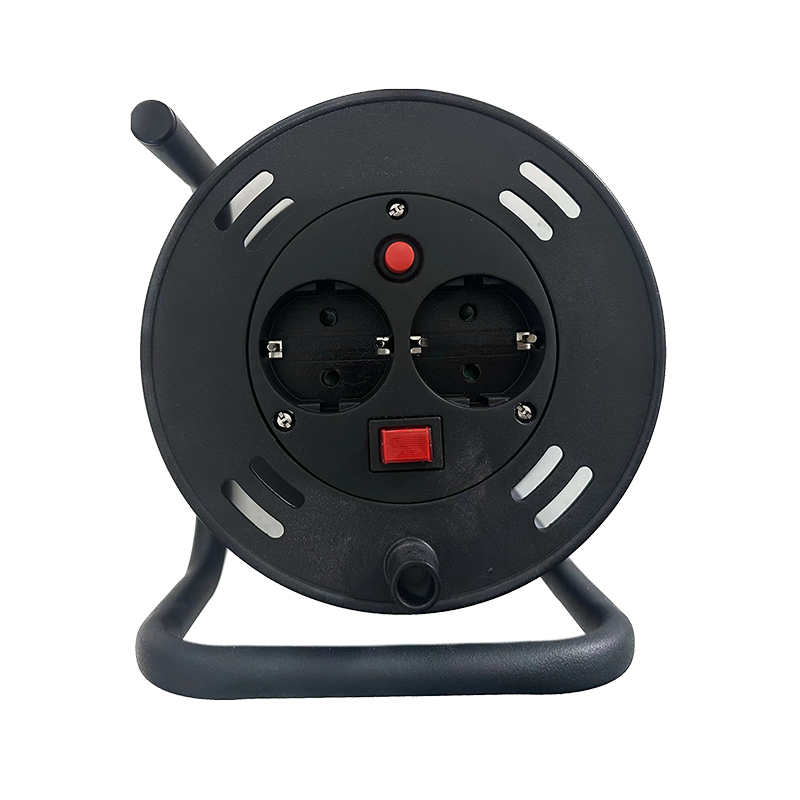
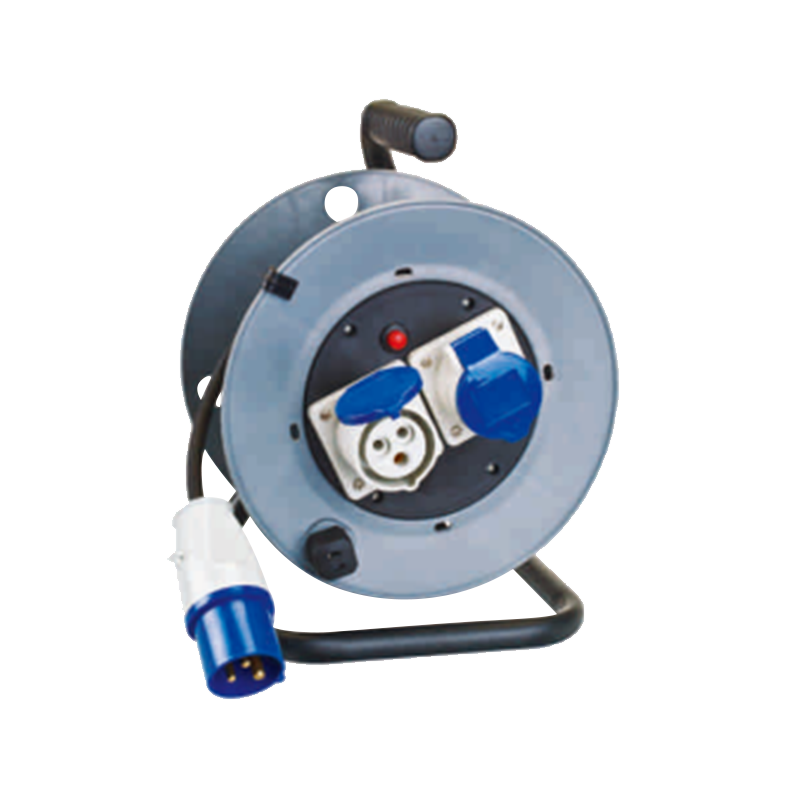 XP03-SY6H 16A/230V Two-Outlet CEE Cable ReelA versatile wall or trolley mounted reel with two CEE outlets and 25m rubber cable, ideal for standard single-phase workshop power distribution.View Product →
The full industrial cable reel range covers these mounting options with different cable lengths, outlet combinations, and frame materials, so the final choice should be driven by how often the reel is moved rather than by the appearance of the drum.
Ratings, Standards, and Environmental Protection
Two sets of numbers define what an industrial reel can do. The IP rating defines what the enclosure can keep out, and the connector rating defines what can be connected to it. Both must suit the installation site.
| IP rating | Protection against solids | Protection against water | Typical reel application |
|---|---|---|---|
| IP20 | Fingers and objects larger than 12 mm | No water protection | Clean indoor workshops |
| IP44 | Tools and wires larger than 1 mm | Splashing water from all directions | General industrial and covered outdoor use |
| IP54 | Limited dust ingress | Splashing water | Dusty production areas and humid workshops |
| IP65 | Dust-tight | Jets of water | Washdown areas and demanding outdoor sites |
For most workshops and construction sites, IP44 is the practical minimum because it covers accidental splashes and light rain. If the reel sits in a machining area with coolant mist or on a site where it may be hosed down, choose IP54 or IP65 even if it costs more.
| Connector | Voltage | Poles | Typical application |
|---|---|---|---|
| 16 A three-pin | 200-250 V AC | 2P+E | Single-phase tools, lighting, small machines |
| 16 A four-pin | 100-130 V AC | 2P+E | 110 V centre-tapped construction supplies |
| 16 A five-pin | 380-415 V AC | 3P+N+E | Three-phase motors and industrial equipment |
| 32 A five-pin | 380-415 V AC | 3P+N+E | Larger three-phase machines and welders |
The key purchasing mistake is matching the reel to the plug on the machine instead of matching it to the machine current under full load. A machine with a 32 A plug does not necessarily draw 32 A continuously, but a reel that is rated for 16 A must never be used as a permanent supply for it. The nominal current printed on the drum is a continuous rating, and a good manufacturer tests the reel with the cable fully extended at that current until thermal equilibrium is reached.
Cable Selection and Voltage Drop
Cable choice affects current capacity, mechanical life, and voltage stability. The chart below shows the calculated voltage drop for a 16 A single-phase load at 230 V using 1.5 mm² and 2.5 mm² copper conductors: the general rule is that the cable on the reel must be sized for both the load and the run length.
Reference values for 16 A at 230 V AC using copper conductors. Voltages above 5% drop can cause motors to overheat and electronic tools to malfunction.
Two practical conclusions follow. First, a 16 A reel with 1.5 mm² cable is fine for runs up to roughly 30 m, but beyond that the voltage at the tool drops below the recommended 5% threshold and performance suffers. Second, 2.5 mm² cable allows the same 16 A load to be served over 50 m with acceptable loss, which is why longer reels almost always use the larger conductor. When you see a 50 m industrial reel, check the conductor size on the specification sheet: a 50 m reel that still carries 1.5 mm² cable is a compromise that will disappoint on real loads.
A useful comparison for a 16 A load: at 30 m, the loss on 1.5 mm² cable is roughly 5%, while 2.5 mm² cuts it to roughly 3%. At 50 m, 1.5 mm² reaches about 8%, which is beyond the recommended limit, while 2.5 mm² stays near 5%.
A Practical Buying Checklist for Industrial Cable Reels
Rather than starting from the catalogue, start from the working conditions. The six points below capture the load, the environment, and the expectations of the people who will use the reel every day.
Connected load
Add up the current that the tool or machine actually draws during operation, not the number printed on its nameplate. Allow a margin of at least 20% for startup current and older machines.
Voltage and phases
Confirm the supply: 110 V, 230 V single-phase, or 380-415 V three-phase. The reel outlet must match the supply, and the plug must be appropriate for the local socket standard.
Cable length
Measure the real distance from the supply point to the farthest work position. A longer cable adds weight, increases voltage drop, and doubles the time spent winding. Choose the shortest length that covers the working area.
Number of outlets
Decide whether operators need one outlet or several. Multi-outlet reels reduce the need for separate distribution leads, but the total connected load must not exceed the reel rating.
Environment
Indoor, outdoor, dusty, wet, or washdown conditions set the IP rating. Metal frames are preferred where impacts are likely; plastic drums are lighter and corrosion-free in wet or chemical exposure.
Certifications
Look for CE, GS, VDE, or an equivalent national certification, and for RoHS compliance. The test reports should cover thermal behaviour, IP protection, and dielectric strength, not just the plug type.
Example calculation: a metalworking cell has a 16 A / 230 V single-phase supply, one operator using an angle grinder and a work light, and the nearest socket is 28 m away. A 30 m reel with 1.5 mm² H07RN-F cable and two CEE outlets matches the supply and keeps the voltage drop within limits. If the same operator moves every day to different positions, a trolley-mounted version with a slightly longer cable is the better mechanical choice.
Safety Mechanisms in a Well-Designed Unit
The difference between a cheap reel and a safe industrial reel is visible in details the buyer cannot see from a product photo. Thermal protection has already been mentioned; grounding is the next priority. The earth conductor in the cable and the earthing contact in every outlet must be continuous from the supply plug through the drum to the socket. A damaged earth wire inside the reel is a latent fault that can electrify a tool housing, so reputable manufacturers test continuity as a routine step on every assembled unit.
The cable guide and the anti-twist ring are safety features as much as convenience features. Without them, the cable twists as it is pulled out, which creates loops and kinks, and these are the points where the sheath eventually splits. The winding behaviour of the drum also matters: a reel that winds unevenly will jam, and an operator who has to force the cable back in can easily damage both the cable and the ratchet. If the reel is used outdoors, an integrated residual current device is recommended, because even an IP44 housing cannot protect against a cable that has been cut by a shovel or a sharp edge.
The way a reel protects its own cable under repeated winding and partial extension is the subject of our article on why cable protection matters on industrial reels. The short version is that mechanical protection, not just electrical protection, is what makes a reel cost-effective over a ten-year service life. For teams that need to power several tools from one position, a three-outlet CEE reel reduces the number of distribution leads running across the floor.
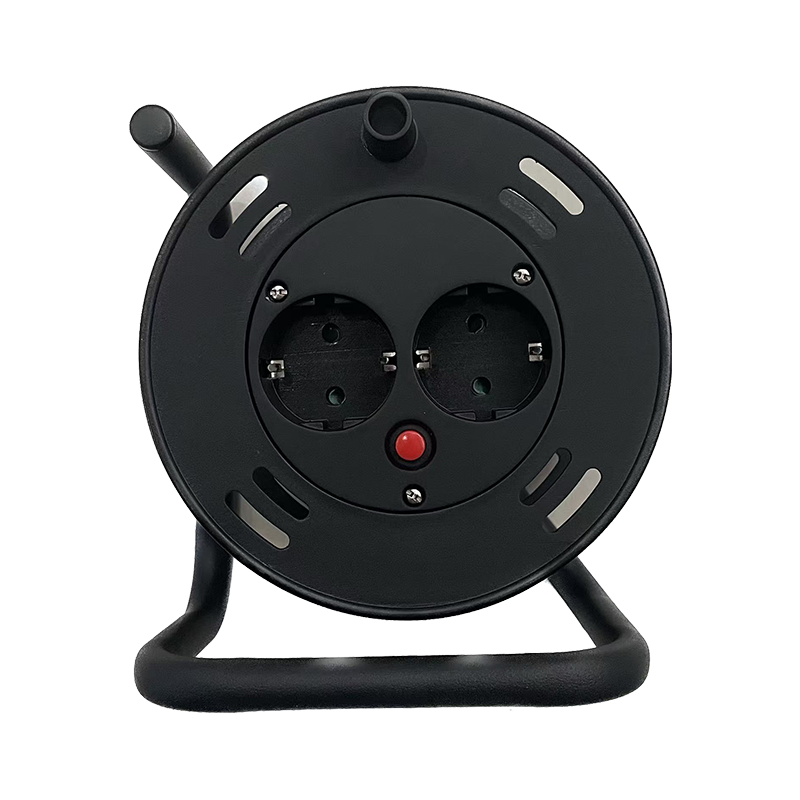
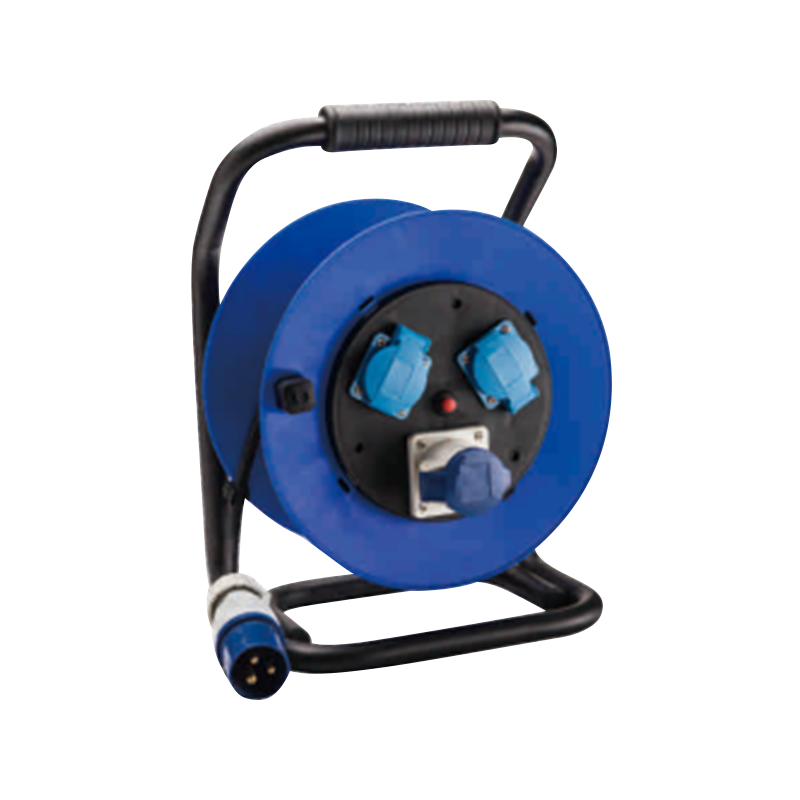 XP06-1 EZ51-D 16A/230V Three-Outlet CEE Cable ReelThis 40-meter reel offers one CEE and two Schuko outlets, providing centralized power for multiple tools in heavy-duty settings.View Product →
Maintenance and Inspection Routines
An industrial reel is a mechanical product, and mechanical products need a routine. Most failures come from neglect rather than from manufacturing defects, and the inspection points below take only a few minutes per week.
- Visually inspect the full length of the cable sheath before the first use of each shift. Look for cuts, flat spots, swelling, or embedded particles that can compress the cable and cause local heating.
- Unwind the full length of cable before applying a high load. A cable coiled on the drum cannot dissipate heat effectively, and running a full load on a coiled reel is the most common cause of insulation failure.
- Check the plugs and socket outlets for discolouration, burn marks, or loose fitting of the contacts. A darkened contact is evidence of resistance and must be corrected before further use.
- Test the thermal protection once every few months by deliberately overloading the reel with the cable fully extended and verifying that the reset button trips.
- Clean the drum, cable guide, and outlet housing with a dry cloth. Remove oil, dust, and metal particles that can creep into the socket contacts.
- Confirm that the rewind spring and ratchet stop work smoothly along the whole cable length, not only at the fully extended position.
- Measure insulation resistance between conductors and earth with an insulation tester at least once per year, especially for reels that are used outdoors.
- Store the reel in a dry indoor area with the cable fully wound when it is not in use, and protect it from prolonged direct sunlight, which degrades rubber sheaths faster than normal wear.
In winter, pay extra attention to the flexibility of the cable. Rubber sheaths stiffen in cold conditions, and forcing a stiff cable onto a small drum radius can crack the sheath. If the reel lives in an unheated warehouse, warm the room or use a cable type rated for low-temperature flexibility. The maintenance effort is small compared with the cost of replacing a 30 m H07RN-F cable or the downtime caused by a short circuit in the middle of a production shift.
Where Industrial Reels Earn Their Keep
Industrial reels appear in more places than a typical factory tour shows, because they solve the same problem in different rooms: power must reach a moving point without lying unprotected on the floor. On production lines, small wall-mounted reels feed handheld tools that move from station to station. In maintenance, trolley reels follow technicians across large halls with grinders, welders, and vacuum equipment. On construction sites, portable reels provide temporary power for lighting towers and power tools while being re-positioned several times per day.
Three-phase reels are the workhorses for movable machinery. When a motor, a compressor, or a conveyor drive is moved to a different position, a permanent cable installation is too rigid and a loose extension lead is unsafe because of the higher fault currents involved. A 380 V five-pin reel is the standard solution, and it must be paired with H07RN-F cable and correctly keyed CEE outlets so that no one can accidentally connect a single-phase tool to a three-phase supply.
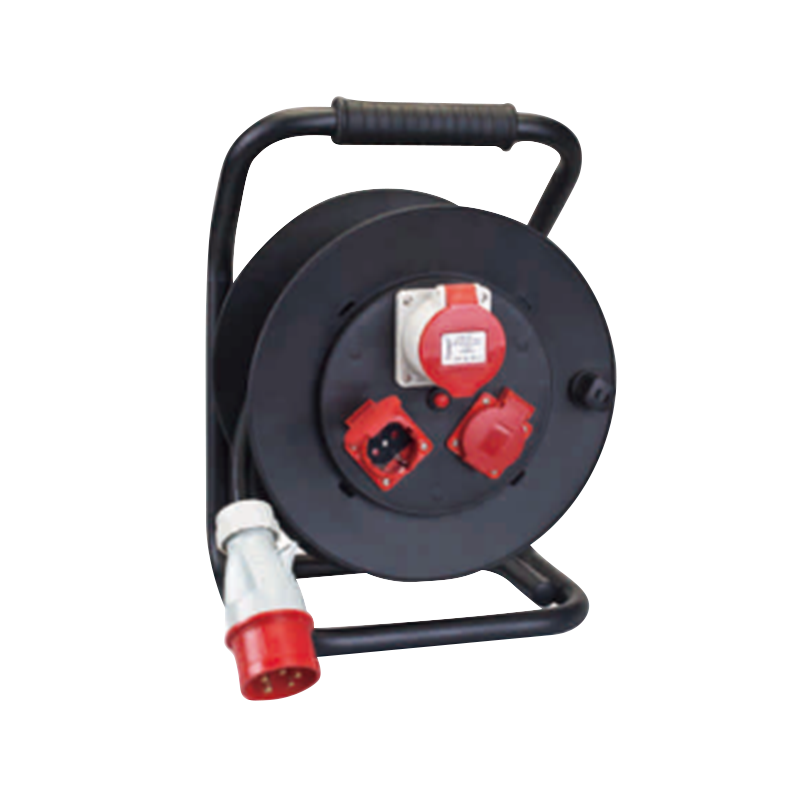 XP06-SY51-D 16A/380V Industrial Cable ReelA three-phase reel with a 380V CEE socket and two 230V outlets, built for movable machinery in demanding industrial environments.View Product →
Outdoor use adds weather and UV exposure. Reels used for garden maintenance, mounted on service vehicles, or placed on temporary event sites need IP44 at minimum, a weatherproof outlet cover while in use, and an RCD between the supply and the reel. The same reel can serve both indoor and outdoor roles if its protection rating and cable type cover the harsher condition, which is why many buyers standardise on one IP44 rubber-cable model instead of maintaining separate indoor and outdoor inventories.
What to Look For in a Manufacturing Partner
Buyers who source industrial reels directly from a factory get a different level of control over the final product. The most important question is not how many units the factory can produce, but which stages of production it actually controls. A manufacturer that produces its own cables, moulds its own drums and housings, assembles the plugs and sockets, and test each reel as a complete assembly can guarantee the interaction between components. A trader who buys drums from one supplier, cables from another, and outlets from a third cannot offer the same consistency.
The visible evidence of this capability is a properly equipped test centre. Our industrial cable reel line is produced at a facility with a VDE test centre inside the plant, which means thermal protection calibration, contact resistance measurement, and dielectric testing are performed on production units rather than only on prototype samples. Certification marks such as CE, GS, VDE, and RoHS are backed by internal records that can be shared with the buyer.
The second thing to check is customisation flexibility. A factory customer may need a different cable length, a different plug type for another country, a specific colour, or a custom label. These are normal requirements for a manufacturer with its own moulding and assembly lines, and they are much harder to obtain from an importer dealing in finished goods. Lead time and shipping logistics also change: a factory near a major port can schedule container loading to match production, which shortens the gap between order confirmation and delivery.
Frequently Asked Questions
Can an industrial cable reel be used for three-phase equipment?
Yes, but only if the reel is specifically built for it. A three-phase reel must have a five-conductor cable, a five-pin CEE outlet, and a plug that matches the supply configuration. The voltage rating must cover 380-415 V, and the current rating must be calculated from the actual motor load. A reel built for single-phase use must never be connected to a three-phase supply, because the outlets are keyed differently and the cable conductors are not sized for phase-to-phase currents.
What is the difference between a 16 A reel and a 32 A reel?
The current rating determines the maximum continuous load the reel can safely deliver with the cable fully extended. A 16 A reel typically uses 1.5 mm² or 2.5 mm² cable and is suitable for most hand tools and small machines. A 32 A reel uses larger conductors and heavier CEE connectors for equipment such as welders, compressors, and larger motors. The higher the rating, the heavier the cable, the drum, and the connectors, so do not buy a 32 A reel for a 10 A tool simply to have more headroom: the extra weight and cost are not justified.
When should H07RN-F cable be preferred over H05RR-F?
H07RN-F is the safer choice for almost every industrial application. Its 450/750 V rating, oil resistance, and stronger sheath make it suitable for workshop floors, outdoor use, and exposure to mechanical stress. H05RR-F is lighter and cheaper and can be used in clean indoor conditions with light mechanical exposure, but the saving is small compared with the cost of replacing a damaged cable and the downtime involved.
How does thermal overload protection reset?
Most industrial reels use a bimetallic thermal switch with a manual reset button. When the internal temperature exceeds the preset limit, the switch disconnects the live conductor. The operator must find the cause of the overheating, allow the reel to cool, and then press the reset button to restore the supply. The manual reset requirement prevents the reel from cycling back into an overload condition repeatedly on its own.
Can a metal reel be used outdoors?
Yes, provided the metal parts are corrosion-protected and the electrical connections are sealed to the required IP rating. Powder-coated steel frames are common on professional outdoor reels. That said, plastic drums are often preferred for outdoor storage because they do not rust and are lighter to carry. The more important outdoor factors are the cable type, the IP rating of the socket, and the presence of an RCD in the supply chain.
What cable length should I choose?
Measure the distance from the supply point to the farthest machine, then add a few metres for movement and connection slack. A longer reel is not an advantage if it is never fully unwound, because cable that remains coiled is more prone to overheating and takes up more storage space. For a workshop with distances under 25 m, a 30 m reel is a sensible standard; for open yards or large halls, 50 m with 2.5 mm² cable is the more reliable configuration.
Making the Final Decision
The right industrial cable reel is the one that matches the supply, the load, the distance, and the environment together. Confirm the actual load by measurement or nameplate, verify the supply voltage and phase count, and measure the cable run before comparing models. Check the conductor size, the IP rating, the outlet configuration, and the certifications on the specification sheet, and ask the manufacturer for test data if any of these are unclear.
Ordering a batch of reels for a plant is a decision that pays off in daily usability. A reel that winds smoothly, runs at a safe temperature, and survives years of workshop use is cheaper than a cheaper alternative that fails on the first three-month inspection. Since the product is manufactured directly in our factory, custom lengths, plug types, and labelling can be coordinated at the same time, which simplifies stocking and maintenance for the end user.