

 Language
 русский
 中文简体
 Español


What IEC 60309 Means: Colour Coding, Clock Positions, Ratings and Safety
What does IEC 60309 mean in practice?
IEC 60309 is the international standard that defines plugs, socket-outlets, connectors and inlets for industrial power supply. These are the heavy-duty, round electrical connectors commonly called CEE plugs, CEE sockets, industrial plugs, or "Commando" connectors. The standard was created so that industrial power connections look, behave and perform the same way in different countries, regardless of domestic plug design, local wiring colour conventions or national grid layouts.
In plain terms, IEC 60309 is what makes a 16 A blue socket in Germany accept the same plug as a 16 A blue socket in the UK, Australia or the Middle East. It is also what stops a 230 V plug from being forced into a 400 V socket. That protection against wrong connection is not accidental; it is engineered through pinned dimensions, colour marking and a clock-face keying system described in this article.
The standard influences every stage of industrial electrical work: selecting a generator connection, wiring a wall socket on a production line, supplying temporary power to construction equipment, or installing a weatherproof outdoor outlet in a marina. If you are a plant engineer, a maintenance electrician, an OEM designer or a distributor sourcing electrical components, IEC 60309 is the framework that defines the safe boundaries of your power connection.
Standard series
IEC 60309 (formerly CEE 17 and IEC 309)
Name
Plugs, socket-outlets and couplers for industrial purposes
Voltage range
20 V to 690 V AC, classified by colour
Current ratings
16 A, 32 A, 63 A, 125 A and higher
Pole configurations
2-pole, 3-pole, 4-pole and 5-pole versions
Protection levels
IP44 splash-proof to IP67 immersion-proof
Where did the standard come from?
Before IEC 60309 existed, industrial electrical connections in Europe were a patchwork of national designs. A socket mounted on a machine built in one country might not accept a plug from the equipment brought in from another, and there was no consistent way to prevent a low-voltage plug from being inserted into a high-voltage outlet. In the 1960s, the CEE organisation brought together European manufacturers and test bodies to create a common connector specification. That specification, known as CEE 17, soon spread beyond continental Europe. In the United Kingdom it was published as BS 4343, which is why British engineers still sometimes refer to these connectors as "CEEform" or "BS 4343" plugs.
As the specification gained international acceptance, the IEC adopted it and issued it as IEC 309. When the IEC renumbered its publication series to a unified system, the standard became IEC 60309. Today the technical requirements are harmonised in Europe as EN 60309, which means a plug certified in one European country is accepted across the whole region.
Many older catalogues and electrical drawings still mention "IEC 309" or "CEE 17". These all refer to the same connector family that is now formally known as IEC 60309.
The history matters for buyers because you will regularly encounter all three names. If a spec sheet says "CEE 17 compliant", "IEC 309 compliant", "BS 4343 compliant" or "EN 60309 compliant", the underlying dimensional and electrical requirements are effectively the same family. Knowing this avoids confusion when comparing products from different suppliers.
How the standard is structured
IEC 60309 is not a single document; it is a series of parts, each covering a specific segment of industrial connection hardware. Understanding the part numbers helps you read datasheets and certifications correctly.
| Part | Scope | What it means for buyers |
|---|---|---|
| IEC 60309-1 | General requirements: construction, materials, safety, testing and IP ratings | The base level of quality assurance for every product in the family |
| IEC 60309-2 | Dimensional compatibility: pin diameters, contact layout, clock positions and colour coding | Guarantees that a plug from one manufacturer fits a socket from another |
| IEC 60309-4 | Switched socket-outlets with interlock | Prevents unplugging under load; used for high-power industrial outlets |
| IEC 60309-5 | High-protection couplers rated IP65/IP66 and above | Used for harsh outdoor and wet environments, including charging applications |
Part 3 previously covered versions with auxiliary contacts and has since been withdrawn, but you may still see references to it in older documentation. For everyday sourcing work, Part 2 is the most important because it specifies the mechanical keying that physically prevents mismatched voltage connections.
The colour coding system explained
The most visible feature of an IEC 60309 product is its housing colour. That colour is not a design choice. The standard assigns a specific colour to each voltage and frequency class, so a blue plug always means 200 to 250 V, a red plug always means 380 to 480 V, and a yellow plug always means 100 to 130 V. A black housing indicates 500 to 690 V systems.
| Housing colour | Voltage range | Clock position | Typical supply |
|---|---|---|---|
| Yellow | 100–130 V | 4 h | 110 V site transformers, export equipment for 110 V grids |
| Blue | 200–250 V | 6 h | 230 V single-phase supply, the most common in Europe |
| Red | 380–480 V | 9 h | 400 V three-phase supply for motors, machines and fixed plants |
| Black | 500–690 V | 12 h | 690 V industrial networks, large drives and mining equipment |
The standard also covers less common classes: violet for 20–25 V systems, white for 40–50 V systems at higher frequencies, green for 400–500 Hz supplies, and grey for 500–690 V systems at non-standard frequencies. These are rarely seen in general trade, but they exist so that the same physical safety logic applies even in specialist sectors such as aerospace ground support and railway maintenance.
For an importer or an OEM, the colour is the fastest way to confirm whether a component matches the target market. If you are assembling equipment for the United Kingdom construction sector, you will want yellow 110 V connectors. If you are wiring standard European machinery, blue and red are your working colours.
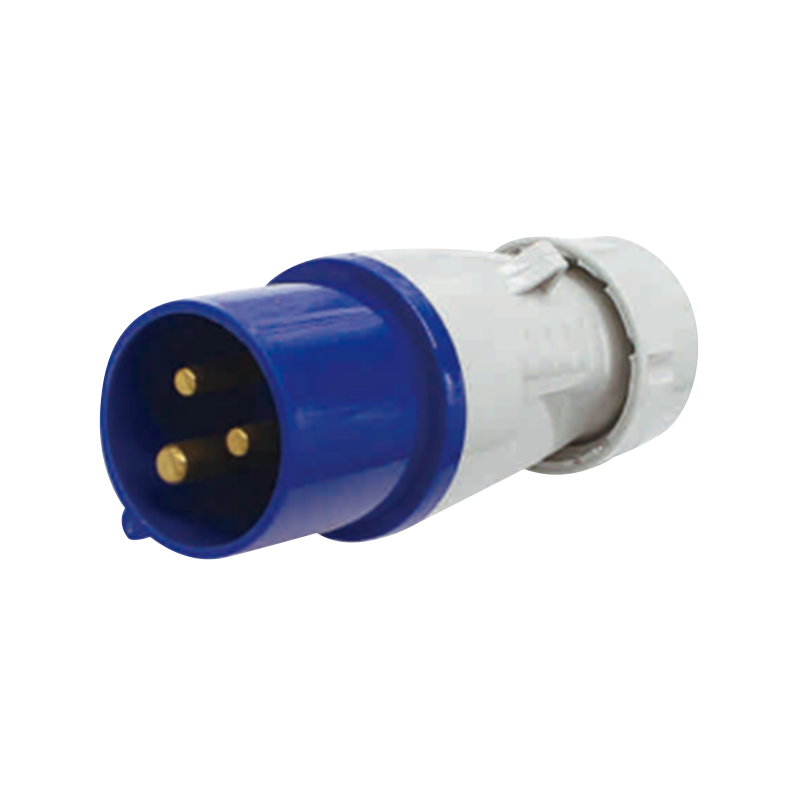 GP51 CEE 16A 6H Three-Pin Industrial PlugThis 200-250V 16A plug with 2P+E and IP44 rating offers color-coded keying and clock-position alignment for safe three-phase connections in industrial settings.View Product →
Clock positions: how the earth pin stops the wrong connection
Colour alone is not enough to guarantee safety. A person working in poor light could still pick up a blue plug and a red socket, so IEC 60309 adds a physical keying system based on clock positions. When you look at the face of an IEC 60309 socket, imagine the connection holes arranged around the centre like hour marks on a clock. A small keyway slot is located at the bottom, at the 6 o'clock position. The earth contact is located at a different hour position depending on the voltage class. The plug body has matching projection and keying details, so it can only be inserted into a socket with the same earth pin position.
This means a blue 6 h plug simply cannot be pushed into a red 9 h socket. It is not a matter of force or friction; the physical keying blocks the insertion completely. That is the single most valuable safety feature of the standard, because incorrect connection in industrial systems can cause phase-to-phase short circuits, damaged motors, destroyed electronics and serious operator injuries.
The same keying principle also separates current ratings. A 16 A and a 32 A product in the same voltage class use different pin diameters, so you cannot insert a 32 A plug into a 16 A socket. This combination of voltage keying and current keying makes the system extremely difficult to misuse, provided the correct part is selected in the first place.
Current ratings, poles and pin configurations
IEC 60309 products are manufactured for a range of current ratings. The most common ratings in European industry are 16 A and 32 A, followed by 63 A and 125 A for larger machines, generators and distribution panels. As the current rating increases, the pin diameter and contact surface area increase in a stepped pattern, which is why a 63 A plug is visibly bulkier than a 16 A version.
| Current rating | Approximate pin diameter | Typical applications |
|---|---|---|
| 16 A | 5 mm | Power tools, small machines, site lighting, generators, outdoor appliances |
| 32 A | 6 mm | Larger machines, compressors, welders, catering equipment, EV charging points |
| 63 A | 8 mm | Machine tools, HVAC plant, distribution boards, heavy industrial equipment |
| 125 A | 10 mm | Large generators, mains distribution, industrial process equipment |
The number of pins determines the type of circuit the connector can carry. A 3-pin version is normally used for single-phase supplies with protective earth, which covers blue 230 V and yellow 110 V applications. A 4-pin version is used for three-phase supplies without a neutral conductor. A 5-pin version carries three phase conductors plus neutral and earth, making it suitable for mixed three-phase and single-phase loads.
| Pins | Arrangement | Circuit type | Where you see it |
|---|---|---|---|
| 3-pin | 2P + E | Single phase with earth | 230 V site supply, 110 V site transformers, outdoor sockets |
| 4-pin | 3P + E | Three phase without neutral | Motors, heating elements, three-phase machinery |
| 5-pin | 3P + N + E | Three phase with neutral | Distribution boards, mixed loads, generators with single-phase outlets |
Five-pin versions are also available in the 230 V voltage class where the local distribution system uses 230 V three-phase service. For example, a 16 A five-pin wall socket with a 6 h keyway is supplied when a customer needs both three-phase power and a neutral connection in the same outlet.
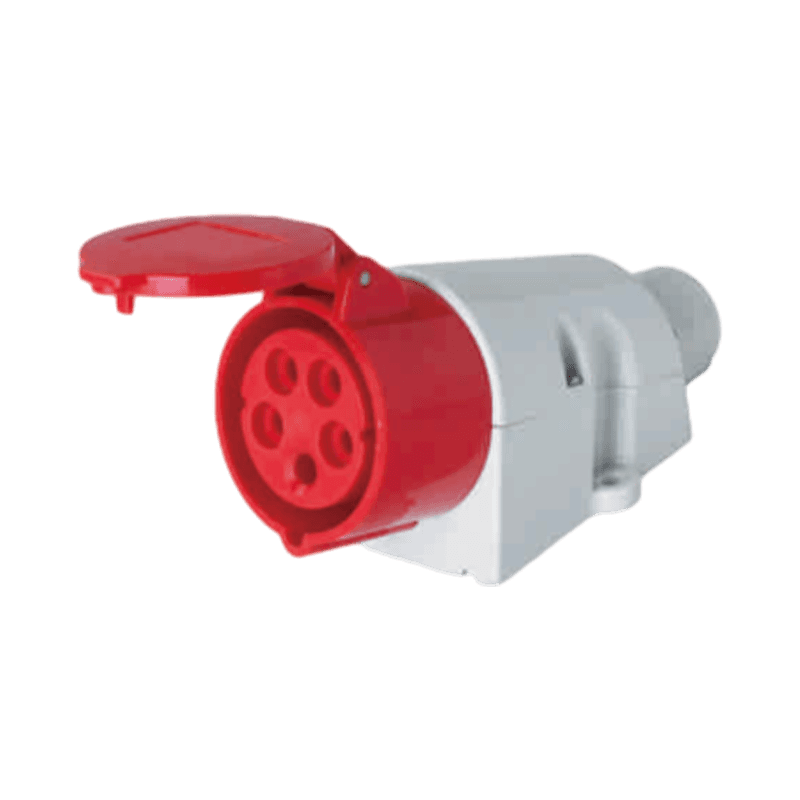 EZ55-M CEE 16A 6H Five-Pin Wall SocketThis IP44-rated 5-pin socket delivers 3P+N+E at 16A and 200/346-240/415V, supporting three-phase power with neutral for versatile industrial equipment connections.View Product →
IP ratings and environmental protection
Industrial power connections are often exposed to water spray, dust, oil mist, vibration and rough handling. IEC 60309 addresses this through the IP classification system. The first digit of the IP rating indicates protection against solid particles, the second digit indicates protection against water. Two ratings dominate the IEC 60309 market: IP44 and IP67.
IP44 means the product is splash-proof. It protects users against tools and wires larger than 1 mm and against splashing water from all directions. Most CEE sockets fitted with spring-loaded lids, including outdoor sockets on building sites and garden power points, are rated IP44 in normal use.
IP67 goes much further. A product rated IP67 is dust-tight and can be temporarily immersed in water to a depth of 1 m for 30 minutes without water entering the enclosure. IP67 versions are found in agricultural applications, food processing plants, washdown areas, ports and any environment where a power point may be hosed directly. The standard also defines IP66 and IP68 variants, but IP44 and IP67 cover the vast majority of industrial and trading requirements.
When selecting a product, check the IP rating together with the housing material. A rubber housing provides better impact resistance and a more secure grip in oily environments, while a well-made engineering plastic housing is lighter and more cost-effective for indoor use. The rated IP class should always match the harshest condition the product will realistically face.
Where IEC 60309 equipment is used in the field
If you have walked through a construction site, a factory floor or an event venue, you have almost certainly seen IEC 60309 connectors. They are the standard power interface in environments where domestic plugs would be unsafe or impractical.
- Construction sites — 110 V yellow supply for power tools via site transformers, plus blue 230 V for lighting and 400 V red for larger equipment.
- Industrial production lines — machine tools, conveyor systems and robotic cells are connected with red 400 V plugs so that maintenance teams can disconnect them quickly and reconnect them without rewiring.
- Events and temporary installations — stage lighting, sound systems, catering units and outdoor marquees use blue 16 A and 32 A sockets fed from generators or distribution panels.
- Marinas and campsites — blue 230 V shore-power connections are the standard interface for boats with single-phase 16 A or 32 A service.
- Outdoor fixed installations — garden sockets, gate motors, pumps and pool equipment are protected with IP44 or IP67 outdoor CEE outlets.
- Electric vehicle charging — many AC charging stations still use a blue 32 A IEC 60309 socket as a simple, certified charging interface.
Each installation comes with specific considerations. A wall-mounted socket in a factory needs a robust mounting and proper strain relief. An outdoor socket needs a sealed hinged lid and the correct IP rating. A socket used for generator connection needs correct earthing and protection against live disconnection. Before doing any wiring work, it is worth reading our step-by-step guide to connecting an industrial socket safely.
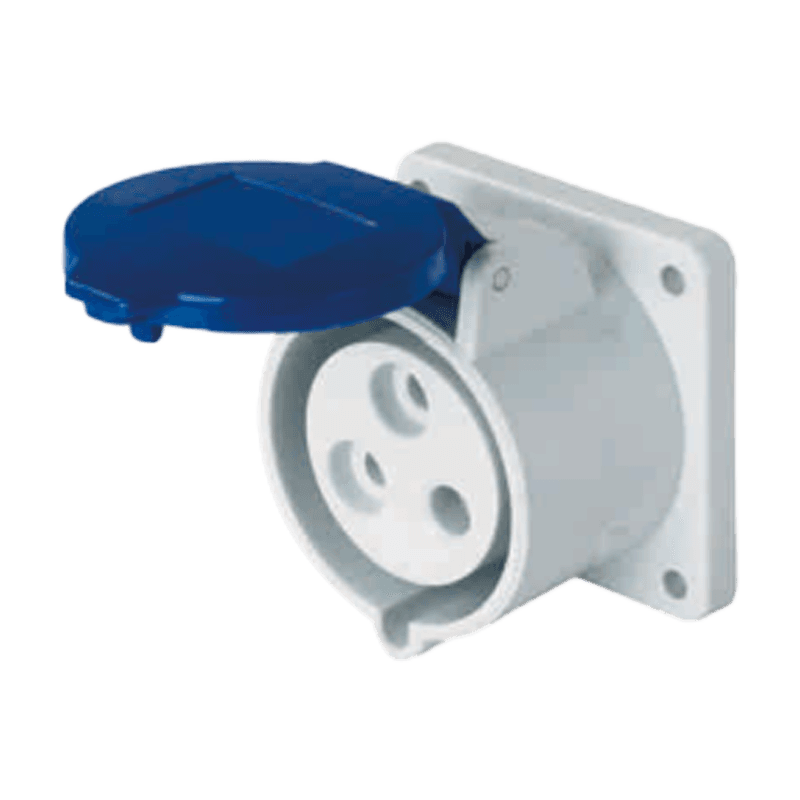 EZ51 CEE 16A 6H Three-Pin Wall SocketThis durable IP44 wall socket rated 200-250V and 16A with 2P+E is designed for factory and workshop installations, offering reliable power for high-demand appliances.View Product →
What to check before specifying an IEC 60309 product
Choosing the right industrial plug or socket is a matter of matching five variables: current rating, voltage class, number of pins, IP protection and mechanical build quality. Each one can cause a real operating problem if ignored.
- Confirm the continuous load, not just the connected equipment rating. A motor may draw 14 A during normal operation but 20 A briefly during start-up. If the load runs close to the rated value for hours, choose the next rating up to avoid overheating.
- Select the voltage class by the network, not by the device nameplate alone. Check whether the supply is single phase or three phase, and whether you need the 110 V, 230 V, 400 V or 690 V class. The colour and clock position will follow automatically.
- Count the conductors. If the circuit includes a neutral conductor, a 5-pin product is mandatory. Using a 4-pin connector for a 3P+N+E circuit would leave the neutral unprotected and is unacceptable.
- Match the IP rating to the environment. IP44 is enough for sheltered industrial areas; IP67 is required for washdown areas, outdoor in-ground use and maritime environments.
- Inspect the internal contacts and wiring terminals. A quality CEE product uses brass or tin-plated contacts with adequate clamping force, clear terminal markings and proper wire stripping guides. Poor contact design is a leading cause of heat damage in imported electrical products.
- Verify certification. Look for certification marks from recognised testing bodies, and confirm that the manufacturer has its own quality control and test facilities. Suppliers with in-house test centres and documented batch testing can supply consistent products for serial production.
When a product passes all six checks, you can reasonably expect years of reliable service. When one check is skipped, that is where field failures appear: a 16 A socket that runs hot, a 400 V plug that loosens under vibration, a splash-proof cover that lets water in after one season.
To compare certified options for your next project, view the full range of industrial plugs, sockets and couplers and check the specification table against your operating conditions.
Common misconceptions about IEC 60309
Several misunderstandings appear again and again in purchasing conversations, and they can lead to expensive mistakes if left uncorrected.
- "All blue plugs are the same." Blue indicates the 200–250 V class, but the current rating, pin arrangement and mechanical keying still need to match. A 32 A blue plug has different retaining groves and pin dimensions than a 16 A blue plug.
- "The colour tells me everything about the product quality." Colour only tells you the voltage class. Two blue plugs from different factories can differ significantly in contact material, plastic grade, sealing performance and certification status.
- "A red plug will not physically fit a blue socket, so safety is automatic." The keying prevents a red 400 V plug and a blue 230 V socket from mating, but it does not protect against exceeding the current rating of an undersized product. A 16 A socket connected to a 32 A load can still overheat even if the plug and socket are mechanically matched.
- "IP67 means the product will never take in water." IP67 is tested for temporary immersion under defined conditions. Continuous submersion, pressure washing with hot water or sealing degradation from age and chemical exposure can still cause water entry.
- "The same IEC 60309 parts cover every frequency." The colour coding distinguishes different voltage and frequency combinations precisely because a connection that is safe at 50 Hz may be unsafe at 400 Hz. Specialist frequency products exist, and they must not be substituted with standard 50/60 Hz parts.
Frequently asked questions about IEC 60309
What does IEC 60309 stand for?
IEC 60309 is the publication number of the International Electrotechnical Commission standard titled "Plugs, socket-outlets and couplers for industrial purposes". It defines the dimensions, electrical ratings, colour coding, protection levels and testing requirements for industrial connection devices.
Is a CEE plug the same as an IEC 60309 plug?
Yes. CEE refers to the original European specification CEE 17 from which the standard grew. CEE 17 became the IEC 309 series, which was renumbered to IEC 60309. A "CEE plug", an "IEC 60309 plug", an "IEC 309 plug" and a "BS 4343 plug" all refer to the same connector family.
What does 6h mean on an industrial plug?
The "h" stands for the clock position of the earth contact when looking at the face of the socket, with the keyway at the 6 o'clock position. A 6h plug has the earth contact at the bottom and is used for 200–250 V systems. The 4h, 9h and 12h positions correspond to 100–130 V, 380–480 V and 500–690 V respectively.
Can I plug a 230 V blue plug into a 400 V red socket?
No. The mechanical keying system prevents this. The earth pin of the blue plug is at the 6h position while the red socket expects the 9h position, so the plug will not enter the socket. Similarly, a damaged or modified plug that forced the connection would be extremely dangerous and must never be used.
Which IP rating should I choose for an outdoor industrial socket?
For sheltered outdoor areas, IP44 is the minimum sensible choice. For exposed positions, washdown zones, coastal environments or sockets that may be hosed directly, choose IP67. The IP rating should be verified together with the housing material and the lid seal, because a rating is only meaningful if the whole assembly is correctly closed.
How do I know whether to buy a 3-pin, 4-pin or 5-pin connector?
Count the current-carrying conductors in your circuit. A single-phase circuit with earth needs a 3-pin connector. A three-phase circuit without neutral needs a 4-pin connector. And a three-phase circuit with neutral needs a 5-pin connector. Matching the pin count to the circuit is a mandatory safety requirement, not a preference.