

 Language
 русский
 中文简体
 Español


What Is an Industrial 16 Amp Socket? Ratings, Types, Uses and Buying Tips
A 2.2 kW mortar mixer draws about 9.6 A while it runs, and three to five times that for a moment every time it starts. Fed from the domestic socket at the back of a shed, on a long thin extension lead, it produces the familiar symptoms: warm plug pins, a breaker that trips mid-pour, and a motor that hums instead of pulling. Move the same mixer onto a correctly wired 16 amp industrial socket with its own circuit, and it runs all day without complaint. That performance gap is the reason round-pin, colour-coded industrial sockets exist.
The short answer to the question in the title: an industrial 16 amp socket is a heavy-duty connector built to the international IEC 60309 standard, known across Europe simply as "CEE". It is rated to carry 16 amps continuously, it comes in 110 V (yellow), 230 V (blue) and 400 V (red) versions with 3, 4 or 5 pins, and its keyed, sealed construction solves three problems household sockets never face: continuous full-load current, rough handling, and water and dust on real sites. The sections below cover the colour and clock-position system, the power you can actually draw, the choice between mounting formats and pin counts, cable sizing, typical applications, and what to verify before ordering.
Quick answer: An industrial 16 amp socket is an IEC 60309 (CEE) connector rated 16 A continuous, colour-coded 110 V yellow, 230 V blue or 400 V red, with 3, 4 or 5 pins and a keyway "clock position" that locks the voltage-and-pole combination. Typically IP44 or IP67, it delivers about 3.7 kW at 230 V single phase and about 11 kW on a 5-pin 400 V three-phase outlet.
What Exactly Is an Industrial 16 Amp Socket?
First the conclusion, then the detail: a 16 A industrial socket is not a domestic outlet with a round front. It is a differently engineered product, and every visible difference - the shrouded pins, the thick housing wall, the cable gland, the keyway - exists to deal with continuous current, mechanical abuse or moisture.
The 16 A figure is a continuous current rating for the contact system, verified in temperature-rise tests at rated current. IEC 60309 builds a whole family around it: 16 A, 32 A, 63 A and 125 A. The family is deliberately incompatible. Sixteen-amp pins are smaller than 32 A pins and the keyway angles differ, so a 16 A plug physically cannot enter a 32 A socket. That removes one of the classic accidents of temporary power, where a light-duty lead ends up on a heavy circuit it cannot carry.
Inside, the engineering is visible. Housings are normally glass-fibre-reinforced polyamide, with rubber versions for the roughest outdoor duty. Contacts are brass, usually nickel- or silver-plated, recessed in shrouded chambers so no live part is reachable during mating; the earth contact makes first and breaks last. Screw terminals accept 1.5 to 2.5 mm² cores (4 mm² on many models), and a cable gland clamps the sheath so pulling strain lands on the gland instead of the terminal screws. The keyway notch sets the clock position, which is what makes wrong-voltage mating physically impossible.
Colour Codes and Clock Positions: Why Each Plug Fits Only One Outlet
Two codes work together on every CEE product. Colour gives the voltage family at a glance: yellow for 100-130 V, blue for 200-250 V, red for 380-415 V. The clock position - the angle of the keyway, described as an hour on a clock face - locks the exact combination of voltage and poles. Only a plug with the same hour position and pin count will enter a given socket, which is why a 230 V lead cannot be pushed into a 400 V outlet no matter how hard someone tries.
| Colour | Hour position | Pins | Voltage | Typical duty |
|---|---|---|---|---|
| Yellow | 4 h | 3 (2P+E) | 100-130 V | 110 V site power from centre-tapped transformers, standard on UK construction sites |
| Blue | 6 h | 3 (2P+E) | 200-250 V | 230 V single-phase machines, campsite and marina hook-ups |
| Red | 6 h | 4 (3P+E) | 380-415 V | Three-phase motors and heaters that need no neutral |
| Red | 6 h | 5 (3P+N+E) | 380-415 V | Three-phase machines that also need a 230 V neutral for controls |
| Red | 9 h | 4 or 5 | 120/208 V | North-American-style three-phase equipment on export projects |
Read the embossed code next to the keyway before ordering: a full designation states current, poles and hours, for example 16 A 6 h 3P. Sixteen-amp and 32 A products share most hour positions but use different pin diameters, so the two ratings stay separated in the field. When fleets end up mixing 6 h and 9 h leads, that is usually a purchasing decision made from a photo instead of a specification - one of the avoidable errors covered in the checklist below.
Buyers supplying markets that run 110 V site power need the yellow 4 h version in steady volume. Our EZ54M CEE 16A 4H 110V wall socket is made for exactly that duty, with a polyamide body, shrouded contact chambers and a gland sized for the rubber site leads that take the daily punishment.
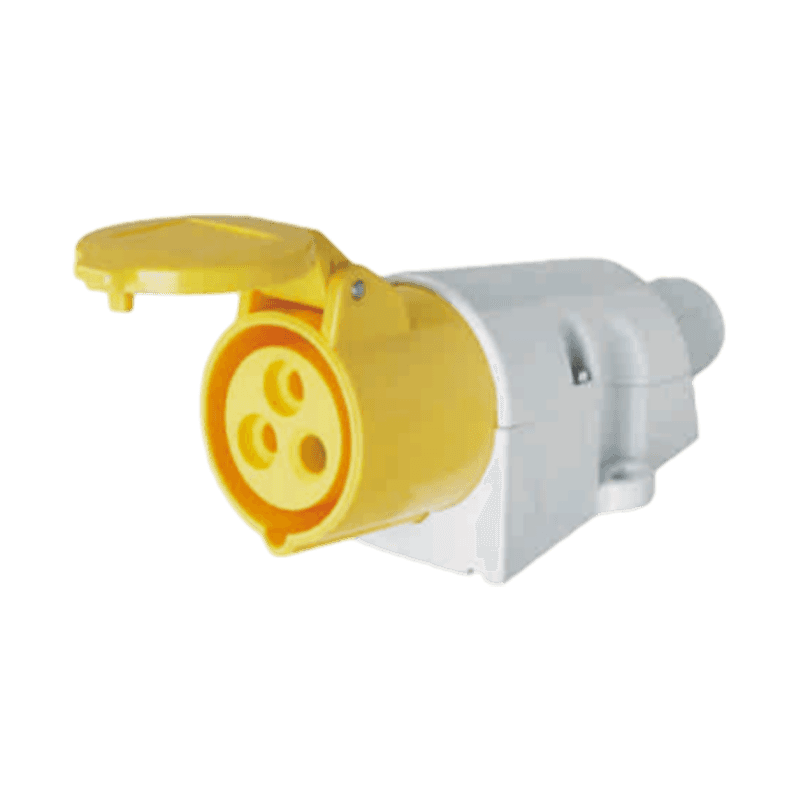 EZ54-M CEE 16A 4H 110V Wall SocketA yellow 110V CEE wall socket with a polyamide body, shrouded contacts and a gland sized for rubber site leads, suited to buyers supplying markets that run 110V site power.View Product →
How Much Power Can a 16 Amp Socket Actually Deliver?
At 230 V, 16 amps is 3,680 watts. That single calculation answers most enquiries: it covers almost every portable machine on a normal site, but not the heavy kit. At 110 V the same socket supplies 1,760 W, and the 5-pin 400 V three-phase version commands about 11 kW, enough for equipment that would otherwise need a hardwired feeder.
The arithmetic is Watts = Volts x Amps. A 2,000 W kettle runs with room to spare; a 3 kW heater sits at the edge; a 2.2 kW mixer is comfortable even with starting surges, because motors draw three to five times their nameplate current for a second or so at switch-on. Those surges are why the breaker and the cable are chosen together with the socket, not as an afterthought.
Available power from a 16 A socket
Watts = volts x amps for single phase; the three-phase figure is 1.732 x 400 V x 16 A. Continuous loads are normally designed to about 80% of these values.
For loads that run for hours without pausing, engineers commonly design to about 80% of the rating - roughly 13 A, or 2.9 kW at 230 V - leaving headroom for surges, warm terminations and long cable runs. If the load sits above that line all day, the correct answer is a 32 A outlet, not a bigger hope.
16 A CEE Sockets vs Domestic Outlets: Where the Difference Shows
On a product photo, a blue 16 A CEE socket and a domestic outlet both look like "a socket". The real differences appear under load, in rain, and after the thousandth mating cycle.
| Feature | 16 A CEE industrial | Domestic 16 A (Schuko) | UK domestic 13 A (BS 1363) |
|---|---|---|---|
| Continuous current | 16 A, temperature-rise tested | 16 A on light-duty contacts | 13 A, fused in the plug |
| Load breaking | Engineered for insertion and removal under load | Not intended as a regular switch | Switch or fuse recommended |
| Ingress protection | IP44 or IP67 when mated or capped | IP20, indoor only | IP20, indoor only |
| Housing | PA6-GF or rubber, gasketed covers | Standard thermoplastic | Standard thermoplastic |
| Contacts | Shrouded, high contact force, keyed | Exposed 4 mm pins | Recessed rectangular pins |
| Cable retention | Screwed gland on the sheath | Basic cord grip | Basic cord grip |
Domestic sockets remain the right choice for indoor, light and occasional use - a desk lamp does not need a CEE connector. The industrial format earns its cost whenever one or more of these applies: the socket lives outdoors, the lead is handled daily, the load is three-phase, or the supply comes from a generator that also feeds other trades.
Wall-Mounted, Portable or Panel-Mounted: Choosing the Format
The electrical core of a 16 A socket is the same in all three mounting formats; what changes is where it lives and how it is serviced. Choose the format first, then the current and poles - not the other way round.
Fixed supply points on workshop walls, columns and machines. Often specified with a switch interlock so the socket cannot be live while a plug is inserted or removed.
Socket inlets travelling on extension leads, cable reels and temporary distribution boards. The most-abused format, where rubber housings and solid strain relief pay for themselves.
Built through the wall of generator panels, distribution boxes and machinery cabinets, front- or rear-wired. When replacing, measure the cut-out and screw spacing rather than trusting a model name.
A simple rule keeps sites tidy: power that never moves goes on the wall, power that moves daily travels on a lead or reel, and power built into equipment goes through the panel.
Each format also raises its own questions about installation height, back-box depth and maintenance access. If you are planning a full workshop or site layout, it helps to see how the different industrial socket types behave in day-to-day applications before fixing the specification.
For the most common case - a 230 V single-phase supply point on a workshop wall - the EZ51 CEE 16A 6H 3PIN wall socket is the reference part: blue 6 h, 2P+E, gasketed cover, and terminals sized for 2.5 mm² cores.
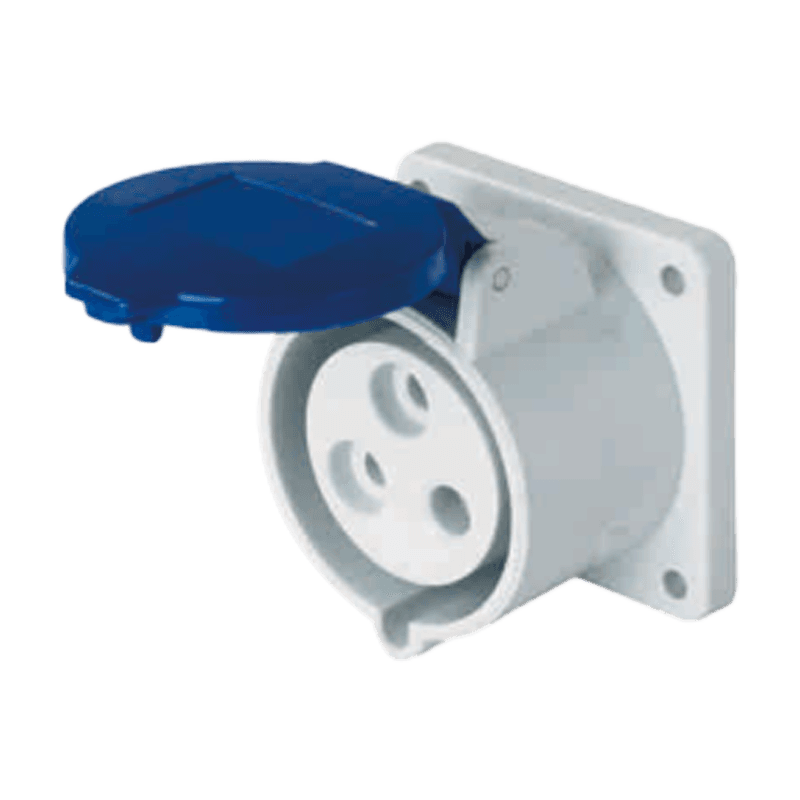 EZ51 CEE 16A 6H 3-PIN Wall SocketThe standard blue 230V 2P+E workshop wall socket with gasketed cover and terminals sized for 2.5 mm² cores, the usual choice for common single-phase supply points.View Product →
3-Pin, 4-Pin or 5-Pin? Matching the Pin Count to the Load
Pin count is conductor count: lives, neutral and earth. Choose it from the load's nameplate, not from habit.
3-pin (2P+E)
Single phase: live, neutral, earth. This is the blue 6 h 16 A workhorse that runs mixers, compressors, small welders and campsite hook-ups, and the yellow 4 h version that feeds 110 V site tools.
4-pin (3P+E)
Three phases plus earth, no neutral. Correct for balanced three-phase loads such as motors, heaters and site transformers, at 400 V red.
5-pin (3P+N+E)
Three phases, neutral and earth. The flexible option: a 400 V motor and a 230 V control or lighting circuit can share one outlet. The body is slightly larger and the price difference is small, which is why machine builders standardise on 5-pin whenever a single-phase component exists.
When in doubt, check the nameplate: if the machine's control circuit or lamps run on 230 V while the motor runs on 400 V, the socket must carry a neutral - order 5-pin. A 4-pin outlet on a machine that needs a neutral is a warranty claim waiting to happen.
For machine outlets that need that neutral, the EZ552 CEE 16A 6H 5PIN socket is the usual choice, mated with the matching 5-pin plug on a 5G2.5 rubber cable.
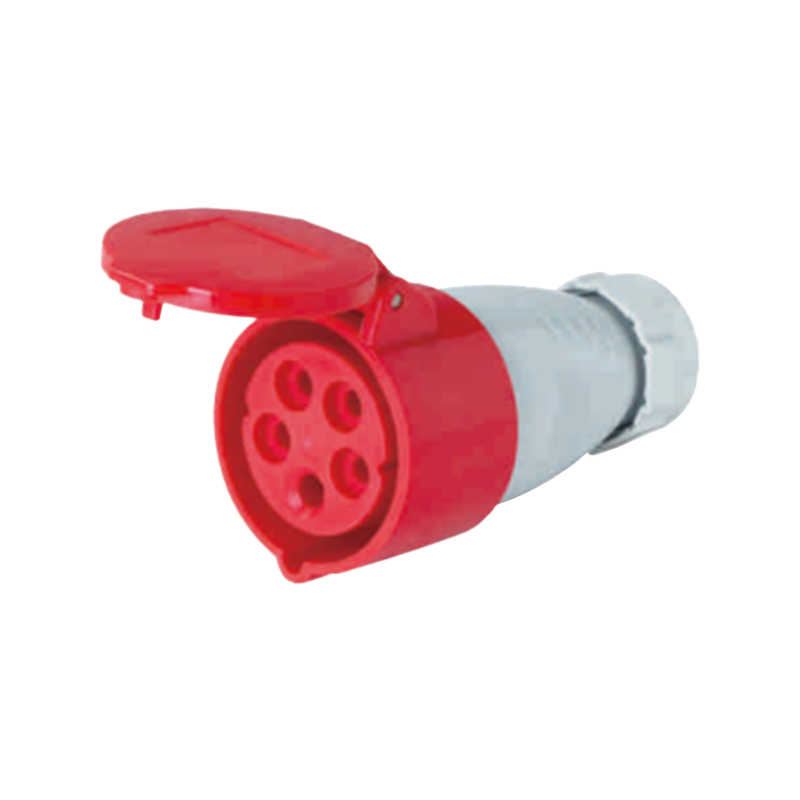 EZ55-2 CEE 16A 6H 5-PIN SocketA 16A three-phase 5-pin CEE socket that provides a neutral conductor for machine outlets, normally paired with a matching plug on 5G2.5 rubber cable.View Product →
IP44 or IP67? Matching Ingress Protection to the Site
The IP code has two digits: the first covers solids, the second liquids. IP44 keeps out objects larger than 1 mm and water splashed from any direction; IP67 is dust-tight and survives 30 minutes at 1 m of immersion. The practical question is what the socket will actually meet, not which number is bigger.
Where IP44 is the sensible choice
Workshops under a roof, outdoor walls in sheltered positions, campsite and marina hook-ups, garden and agricultural points. With the cap closed or a plug mated, IP44 shrugs off rain and hose-adjacent splashes, which covers the majority of outdoor installations.
When IP67 earns its price
Wash-down areas, docks and seafronts, exposed exterior walls with driving rain, dusty grain and fertiliser stores, and anywhere a hose gets pointed regularly. Paying for IP67 in a dry indoor workshop buys nothing; fitting IP44 beside a pressure washer costs a socket every season.
IP ratings describe the mated condition or the capped condition. An open, unmated socket lying in a wheelbarrow is IP00, whatever the datasheet says - so check that the cap springs still close the lid during inspections.
Seals age. During maintenance, look at gaskets and cap springs first; those are the parts that quietly decide whether the rating on the label is still true in year five.
Cable Cross-Section and Voltage Drop: The Step Buyers Often Skip
A 16 A socket is only as good as the cable behind it. Two decisions matter: cross-section and length.
For fixed installations, 2.5 mm² is the standard minimum on a 16 A circuit, with 4 mm² for longer runs. For portable leads, rubber cable is the outdoor default - H07RN-F 3G2.5 for rough and wet duty, H05RR-F indoors - because rubber jackets stay flexible in cold weather and resist abrasion in a way PVC does not.
Voltage drop is the silent performance killer. At 230 V, 3% is 6.9 V - the usual design target - and 5% is the practical ceiling. Beyond that, motors start hot, heaters underperform and breakers trip on marginal faults.
Typical round-figure values for copper cable at 16 A: voltage drop grows linearly with run length. Read the chart in round numbers - 1.5 mm² crosses the 3% design limit near 18 m, while 2.5 mm² holds it to about 30 m.
Past roughly 40 m, either step up to 4 mm² or move the socket closer to the load. This is also why 110 V site systems keep transformers near the point of use: at lower voltage, the same watts mean more amps, and more amps mean faster drop.
Where 16 Amp Industrial Sockets Are Used
Sixteen amps is the sweet spot of temporary power: the highest rating that still runs on light, flexible 2.5 mm² cable - about the practical limit of what a person coils and carries all day. That is why it dominates these settings:
- Construction site distribution: site boards feeding mixers, vibrators and lighting; yellow 4 h under the UK 110 V system, blue 6 h on continental sites.
- Workshops: compressors, saws, lathes, small welders and plasma cutters on dedicated wall points.
- Campsites and caravan parks: the blue 16 A CEE outlet is the standard pitch hook-up across Europe.
- Marinas: shore-power pillars feeding boats at pontoon positions.
- Events and stages: temporary distribution for sound, lighting and catering, installed under time pressure.
- Agriculture: pumps, ventilation fans, grain augers and barn lighting in dust and damp.
- Generators: 16 A outlets on portable gensets, enforcing one machine per socket.
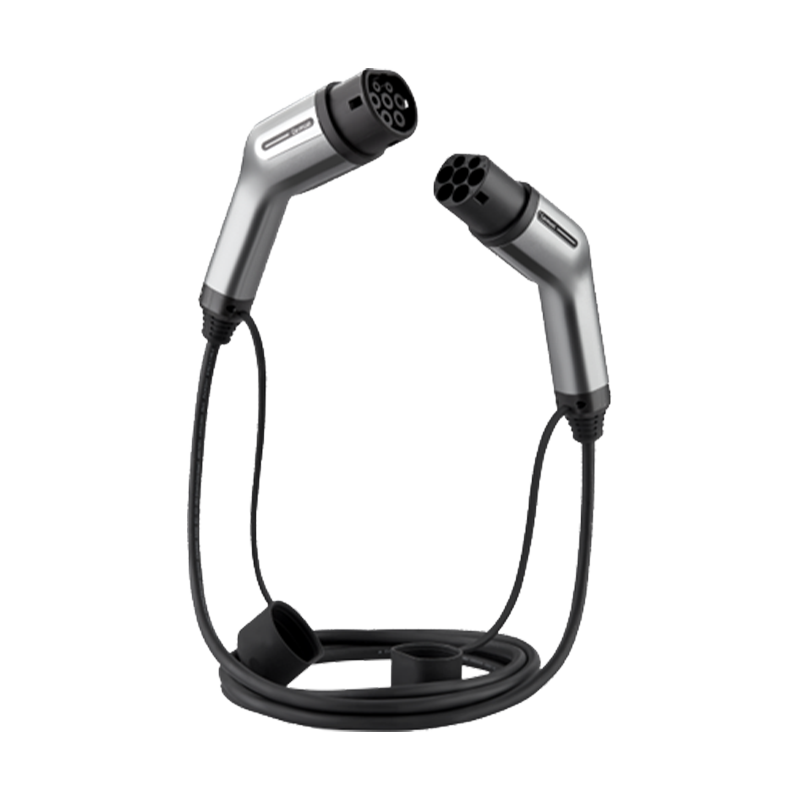
- Yard service posts: robust outdoor supply for portable equipment, including farm EV charging leads.
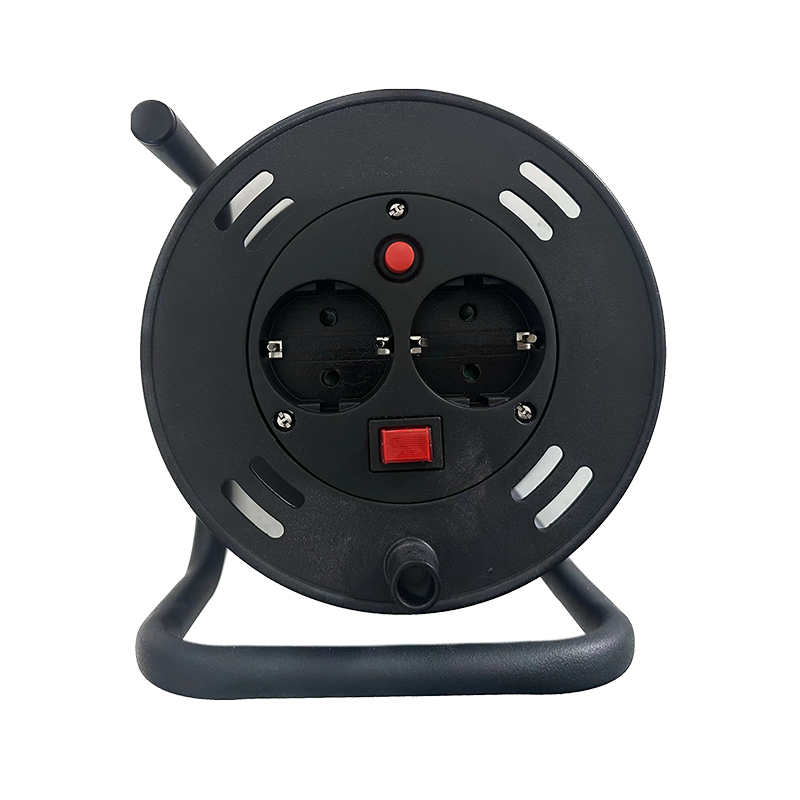
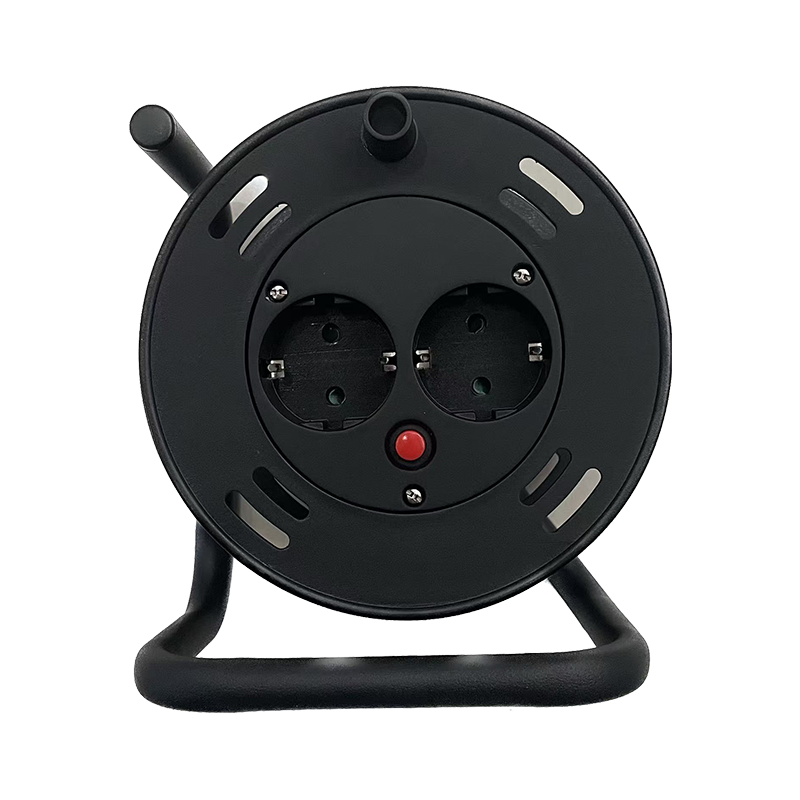
Two adjacent products complete these installations. Industrial timer sockets control lighting or heating schedules on the same 16 A circuits, and industrial cable reels put a 16 A CEE outlet wherever the work moves that day.
Buyer's Checklist: What to Verify Before Placing an Order
Most field failures with industrial sockets trace back to a short list of avoidable mismatches. Confirm these before the purchase order, not after the container arrives:
- Voltage and clock position of the installed base. Match what the site already uses; a blue 6 h socket is useless where the fleet runs 9 h leads.
- Pin count against the load nameplate, especially the neutral question on three-phase machines.
- Standard compliance and certification: EN/IEC 60309 conformity, third-party marks such as VDE where the market expects them, and test reports on request.
- Housing material against duty: PA6-GF for impact and heat, rubber for cold and rough handling, and a stated low-temperature rating (-25°C or -40°C) where winters are real.
- Contact and terminal detail: brass contacts, plating, conductor range, and terminal screws that hold 2.5 mm² cores at the specified torque.
- Ingress protection in the condition that matters - mated or capped - and how the cap seal behaves after years of service.
- Cable gland range against your actual cable outside diameter, so strain relief works instead of decorating the box.
- Interlock requirements for wall-mounted points, plus a sample test before volume: mating force, temperature rise at 16 A, and cap spring action.
A supplier with an in-house laboratory can answer most of this with reports rather than adjectives. Our own VDE test center exists precisely so that enquiries like these end in measured data.
Installation and Safety Notes Worth Insisting On
On the circuit side: a 16 A socket belongs on a protected circuit with a matching breaker, cable of at least 2.5 mm² (4 mm² on longer runs), and 30 mA RCD protection wherever people work outdoors or on portable equipment. Verify earth continuity at commissioning, not by assumption.
On the product side: specify interlocked wall sockets where plugs are switched often, because the interlock prevents insertion and removal under load. Never defeat the keyway to force a mismatched plug, never fit a domestic plug with cut or filed pins, and re-torque the terminal screws after the first weeks of service - copper creeps, and a loose screw becomes a heat source.
On behaviour: insert and remove plugs fully, use the interlock or a switch instead of disconnecting under load, and keep caps closed on unmated sockets. Labelling each socket with voltage, current and circuit number costs minutes and prevents wrong-lead mistakes that even clock positions cannot catch - for example, two blue 6 h sockets fed from different phases.
Maintenance Intervals That Actually Prevent Failures
Fixed indoor installations: inspect annually. Outdoor and construction environments: quarterly at minimum, or as local regulation requires. Event and hire fleets: before every deployment. Harsh, dusty or coastal sites deserve monthly attention.
The five-minute check covers most failures before they happen: discolouration or heat marks around pins and terminals, contact wear and spring tension, gasket and cap condition, gland tightness, and an occasional insulation-resistance measurement. A thermal camera pass under load finds the loose screw before the loose screw finds you.
A written routine turns these checks into habit rather than intention: same checklist, same points, recorded each time, with any socket that shows heat marks or weak cap springs removed from service on the spot rather than at the next scheduled round.
Frequently Asked Questions
How many watts can a 16 amp industrial socket supply?
At 230 V single phase, 3,680 W; at 110 V, 1,760 W; on a 5-pin 400 V three-phase outlet, about 11,000 W. For loads that run continuously for hours, plan around 80% of these figures, which keeps contacts and terminations cool for the life of the installation.
Can I plug a domestic appliance into a 16 A CEE socket?
Not directly - the pin systems differ. Certified adapter cables, with a CEE plug feeding a single domestic socket, are the accepted solution for temporary supply. The adapter must be fully rated, the circuit must carry RCD protection, and the appliance lead must be undamaged. For anything permanent, use CEE equipment end to end.
What is the difference between 16 A and 32 A industrial sockets?
Current capacity and physical size. A 32 A socket has larger pins, heavier contacts and a different keyway, so a 16 A plug cannot enter it. At 230 V, 32 A is about 7,360 W; three-phase, about 22 kW. Step up when a continuous load exceeds roughly 2.9 kW at 230 V, or when cable runs get long.
What cable should feed a 16 A socket?
Fixed: 2.5 mm² minimum, 4 mm² beyond about 40 m. Portable: H07RN-F 3G2.5 rubber cable outdoors, H05RR-F indoors. Check the voltage drop chart above before finalising long runs - the cable often decides performance more than the socket does.
Why are 16 A sockets different colours?
Colour is the voltage family: yellow 110 V, blue 230 V, red 400 V. Together with the clock-position keyway, it makes wrong-voltage mating physically impossible, which is the standard's single most valuable safety feature.
Are CEE 16 A sockets weatherproof as supplied?
IP44 versions handle rain and splash when mated or capped; IP67 versions add dust-tightness and short immersion. Weatherproofing is a condition, not a permanent property - gaskets and cap springs need checking, and an open socket left uncapped outdoors is protected by nothing.
Sourcing 16 A Sockets Directly From the Manufacturer
Our factory in Cixi, Ningbo has manufactured plugs, sockets, cables, extensions and reels since 1986, operating under ISO 9001, ISO 14000 and ISO 18000 certification with an in-house VDE test center and more than 100 quality-control staff supplying European and American markets.
The 16 A CEE line covers 3, 4 and 5-pin versions at 110 V, 230 V and 400 V, in wall, panel and portable formats, together with the matching plugs, CEE extension leads, industrial cable reels fitted with 16 A outlets, and industrial timer sockets for controlled circuits. Cable length, jacket colour, packaging and labelling are specified to the destination market rather than to a catalogue default.
The full industrial socket range is available on our product pages, with specifications and enquiry details for each model.
The efficient way to start is a short specification: voltage and clock position, pin count, IP rating, mounting format and cable detail. Drawings and a sample for bench testing follow from there, so the first bulk order is placed against measured results, not assumptions.