

 Language
 русский
 中文简体
 Español


What Is an Industrial Socket? IEC 60309 CEE Types, Ratings, and Selection Guide
What Is an Industrial Socket?
An industrial socket is a fixed, panel-mounted or portable electrical outlet built to the IEC 60309 standard, the connector family also called CEE, commando or pin-and-sleeve. It feeds machinery, power tools, welding sets and temporary distribution boards at currents, voltages and environmental conditions that a household outlet was never engineered to survive.
The short test: if an outlet is colour coded, physically keyed so only one voltage can be plugged into it, rated at 16 A or more, and sealed to IP44 or better, it is an industrial socket. If it accepts a domestic plug, it is not.
Three assumptions shape every design decision. First, the load is heavier, usually a motor, a heater bank, a compressor or a distribution board rather than a lamp. Second, the plug will be inserted and withdrawn thousands of times over its life, often by gloved hands in poor light. Third, the environment includes dust, water, oils, coolants, vibration, UV and mechanical impact. Rated current is only one part of the answer to what an industrial socket is; the keying, the contact system, the sealing and the cable entry matter just as much.
The single most important feature is not the amperage printed on the face, it is the keyway and the earth pin position. A blue 230 V 16 A plug will not enter a red 400 V socket, and a yellow 110 V site plug will not enter either. That mechanical interlock is what stops a maintenance technician from destroying a machine, or themselves, by forcing the wrong plug into the wrong supply.
Inside a typical installation the industrial socket sits at the end of the chain: main distribution board, protective device, isolator, socket, plug, cable, machine. Every item in that chain has to be matched, which is why industrial sockets are rated by current, voltage, frequency, pole configuration and IP class at the same time rather than by any single number.
How to Read the Code on an Industrial Socket
Industrial sockets are labelled in a compact code, for example 16 A 6h 3P+E 230 V IP44 blue. Each field answers a different question, and getting one wrong turns a straightforward order into a container of unusable stock.
- Rated current: 16 A, 32 A, 63 A or 125 A are the common steps. The rating is continuous, not a peak value, and it assumes the correct conductor cross-section and ambient temperature.
- Hour position (h): the clock position of the earth pin, such as 6h or 4h. It is a voltage and system marker, and it physically prevents mismatched mating.
- Pole configuration: 2P+E for single-phase with earth, 3P+E for three-phase without neutral, 3P+N+E for three-phase with neutral.
- Voltage and frequency: 110 V, 230 V and 400 V at 50 Hz or 60 Hz are the mainstream export variants.
- IP class: IP44 for general indoor and sheltered outdoor use, IP67 for washdown and wet areas.
- Colour: derived from the nominal voltage, so blue means 200 to 250 V and red means 380 to 480 V.
| Configuration | Rated current | Nominal voltage | Pins | Colour | Typical duty |
|---|---|---|---|---|---|
| 2P+E, 6h | 16 A | 230 V | 3 | Blue | Hand tools, single-phase pumps, bench equipment |
| 3P+E, 6h | 16 A | 400 V | 4 | Red | Three-phase motors without neutral |
| 3P+N+E, 6h | 16 A | 400 V | 5 | Red | Small distribution boards, mixed 230/400 V loads |
| 2P+E, 6h | 32 A | 230 V | 3 | Blue | Welders, heaters, larger single-phase machines |
| 3P+N+E, 6h | 32 A | 400 V | 5 | Red | Workshop distribution, medium drives |
| 3P+N+E, 6h | 63 A / 125 A | 400 V | 5 | Red | Site distribution, container and hall power |
| 2P+E, 4h | 16 A / 32 A | 110 V | 3 | Yellow | Portable tools fed through a site transformer |
The Colour Code and Why It Exists
Colour coding is a language, not decoration. On a busy site a technician can identify the voltage of a socket from ten metres away, which is faster and more reliable than reading a label covered in dust. The colour is tied to the nominal voltage band, and the hour position adds a second, mechanical layer of protection.
| Nominal voltage band | Colour | Where it appears |
|---|---|---|
| 20 to 25 V | Violet | Control and low-voltage auxiliary circuits |
| 40 to 50 V | White | Safety extra-low voltage tools and lighting |
| 100 to 130 V | Yellow | Construction site tools through portable transformers |
| 200 to 250 V | Blue | Single-phase general purpose industrial supply |
| 380 to 480 V | Red | Three-phase motors, drives and distribution |
| 500 to 690 V | Black | Heavy industrial and marine installations |
Two practical consequences follow. A spare yellow 110 V socket cannot be used as a temporary fix on a 230 V circuit, and a mixed stock of blue and red units must be stored separately to avoid assembly errors at the panel. For export projects, the socket has to match the local wiring practice as well as the local voltage: a 16 A CEE socket is the same product in Germany and in Italy, but the upstream protection and the cable sizes used to feed it are not always specified the same way.
Industrial Socket vs Household Socket: The Differences That Matter
The two products look similar from a distance and behave completely differently in service. Household sockets are designed for intermittent, modest loads and untrained users; industrial sockets are designed for continuous load, repeated mating and a hostile environment. The table below sets out the differences that show up in failure reports.
| Property | Household socket | Industrial socket |
|---|---|---|
| Typical current rating | 10 A to 16 A, short duration | 16 A to 125 A, continuous |
| Voltage system | Single-phase only | Single-phase and three-phase |
| Mating protection | None beyond pin shape | Keyway plus earth pin hour position |
| Retention | Friction only | Spring-loaded contacts, often a locking ring |
| Ingress protection | Generally IP20 | IP44 as standard, IP67 available |
| Housing material | Thermoplastic, thin wall | Glass-filled polyamide or polypropylene, impact rated |
| Contact system | Flat brass strips | Massive pin and sleeve contacts, plated |
| Terminations | Small screw terminals | Clamp terminals for 1.5 mm² to 10 mm² conductors |
| Cable entry | Fixed, back entry | Gland or membrane entry, multiple sizes |
| Service life | Hundreds of mating cycles | Thousands of mating cycles |
The most common field failure in industrial systems is not a cracked housing. It is a loose terminal screw. A high-resistance joint heats up, the heat accelerates oxidation, resistance rises again, and the socket eventually discolours or melts around the contact. That is why industrial sockets specify terminal torque, conductor range and a defined inspection cycle, and household sockets do not.
The Main Types of Industrial Socket
Product families differ mainly by how they are mounted and what the environment demands, not by which standard they follow. Choosing the wrong mounting style is one of the most frequent specification mistakes, because a panel socket cannot be surface mounted and a trailing socket cannot be fixed to a wall.
Wall-mounted socket
The workhorse of workshops and plant rooms. Fixed to a surface with two or four screws, cable entry from the back or the bottom. Used wherever equipment is moved but the supply point is permanent.
Panel and flange socket
Recessed into a machine panel or a distribution box. The socket sits flush with the enclosure, which keeps the footprint small and protects the body from impact.
Portable or trailing socket
Fitted to the end of a flexible cable rather than a wall. Common on extension leads, cable reels and mobile distribution units where the supply point moves with the job.
Right-angle socket
Used in tight cabinets and against walls where a straight cable entry would be crushed or would force a minimum bending radius that the cable cannot take.
Interlocked socket
Combines a socket with a switch or isolator so the supply can only be switched on with the plug fully inserted, and the plug cannot be withdrawn under load.
Multi-outlet CEE socket strip
One CEE inlet feeding two or three CEE outlets, typically at 16 A. Popular on site distribution and in workshops where several tools share one feed.
Two further variants are worth knowing. Industrial timer sockets add 24-hour mechanical or digital switching on top of the CEE connection, which is useful for pumps, signage and compressors that should run to a schedule. Combination sockets place a CEE outlet and a domestic outlet in one housing so a single feed serves both industrial and office equipment.
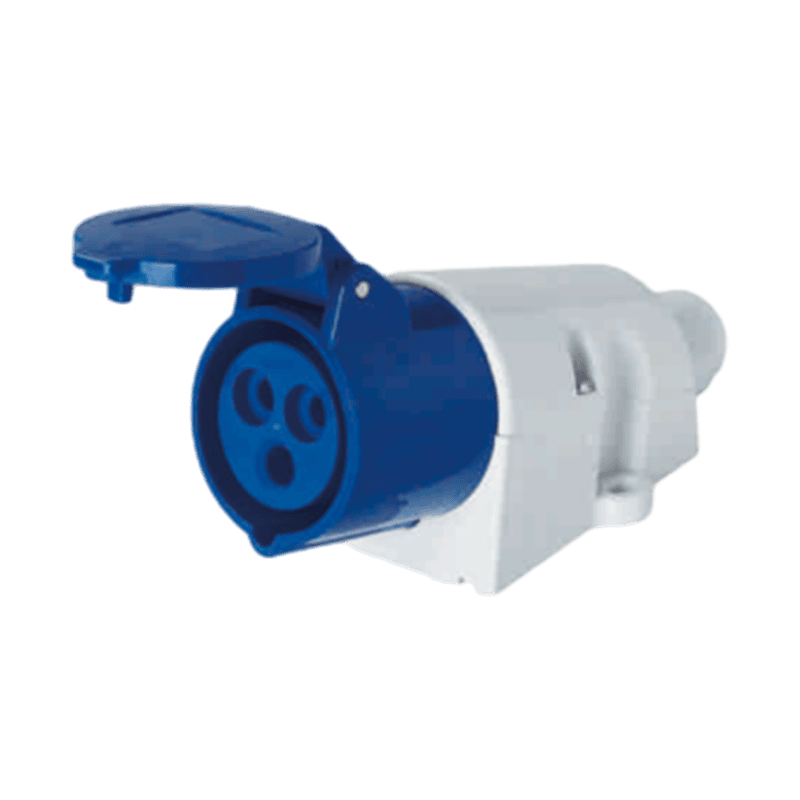 EZ53-M CEE 16A6H 230V Industrial Wall SocketOEM/ODM 16A 6H 230V wall socket with 2P+E and IP44 protection, suited to factories and workshops before comparing industrial socket options.View Product →
You can compare the full range in this overview of different types of industrial sockets before fixing the specification for a project.
What Is Inside an Industrial Socket
Understanding the internal build explains most of the price difference between a budget unit and a long-life unit, and it explains why some sockets survive ten years in a foundry while others fail within one summer.
Housing and insulation
Industrial socket housings are moulded from glass-fibre reinforced polyamide, polypropylene or polycarbonate. The material has to hold its shape at 100 °C at the contact area, resist UV in outdoor mounting, resist oils and coolants, and survive a drop onto concrete at low temperature. Wall thickness and the quality of the moulding compound decide whether the body cracks after a season of impact.
Contacts and sleeves
The live contacts are substantial brass pins or sleeves, often nickel plated to slow oxidation, and the sleeve design keeps fingers away from live metal. Contact pressure comes from a spring element or from the geometry of a split sleeve. If contact pressure relaxes, resistance rises and the socket starts to run warm. This is why retaining spring quality matters more than the visible brass.
Sealing and cable entry
IP44 and IP67 units differ mainly in the seal package: a gasket behind the mounting flange, a sealing ring at the plug interface, and a gland or membrane where the cable enters. A socket with a perfect interface seal and a loose gland will still fill with water, which is why the gland is part of the maintenance checklist and not just the installation.
Terminals
Terminals are clamp or cage type with defined conductor ranges, typically 1.5 mm² to 6 mm² on 16 A devices and 4 mm² to 10 mm² on 32 A devices. Tightening torque is specified by the manufacturer because under-torque creates heat and over-torque deforms the conductor and cracks the terminal body. A calibrated screwdriver is a reasonable investment on any site with more than a few dozen sockets.
Shutters, screws and labels
Shutter mechanisms on certain models reduce the chance of accidental contact; stainless mounting screws prevent corrosion staining on white walls; and laser-etched or pad-printed ratings stay readable when the paper label has long since gone. Small details, but they decide whether a maintenance technician can identify the circuit at a glance.
IP Ratings Explained in Practical Terms
The IP code states two things: protection against solid objects and protection against water. The first digit covers dust and fingers, the second covers liquid. For industrial sockets, the second digit is the one that decides the application.
| IP class | Solid object protection | Water protection | Where it is appropriate |
|---|---|---|---|
| IP44 | Objects above 1 mm | Splashing water from any direction | Workshops, warehouses, sheltered outdoor use |
| IP54 | Limited dust ingress | Splashing water | Dusty production areas with occasional washdown |
| IP65 | Dust tight | Water jets | Food lines, car washes, hose-down areas |
| IP67 | Dust tight | Temporary immersion to 1 m for 30 minutes | Pumps, docks, outdoor sites with standing water |
The realistic rule is to match the IP class to the water, not to the brochure. Fitting IP67 everywhere adds cost and makes the connector harder to mate. Fitting IP44 in a washdown bay ends with water in the housing and a corroded earth pin. Most European industrial installations settle on IP44 indoors and IP67 outdoors or in wet process areas.
How to Choose the Right Industrial Socket
The specification can be fixed in about ten minutes if the questions are asked in the right order.
- Confirm the supply: single-phase or three-phase, nominal voltage, frequency, and whether a neutral is required for control circuits or 230 V loads on a 400 V system.
- Add up the continuous load, not the nameplate peak, and add a margin for motor starting. A 16 A socket is not the right choice for a machine that draws 14 A continuously in a 40 °C workshop.
- Decide the pole configuration. If any part of the equipment needs a neutral, specify 3P+N+E rather than 3P+E, even if the neutral is unused today.
- Choose the IP class from the environment. Indoors and dry: IP44. Washdown, rain or standing water: IP67.
- Choose the mounting style: wall, panel, trailing or interlocked. Consider whether the plug will be removed under load; if so, an interlocked socket is the safer answer.
- Match the cable entry to the cable. A gland sized for a thin cable will not seal, and one sized for a thick cable will not close.
- Check the upstream protection. Industrial sockets need overcurrent protection sized to the cable, and portable equipment on site usually needs residual current protection as well.
- Confirm the standard and the variation used in the destination market, including any colour or marking requirement from the project specification.
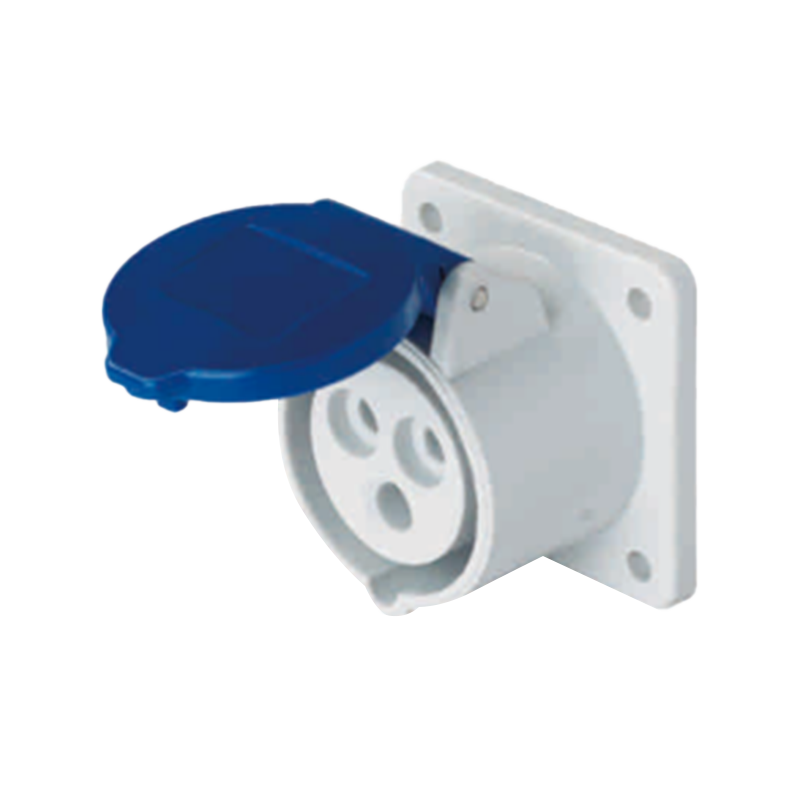 EZ61-2 CEE 32A6H 3-Pin Wall SocketOEM/ODM 32A 6H three-pin CEE socket with IP44 and 2P+E, for high-capacity industrial or commercial connections; verify hour code against voltage.View Product →
A useful sanity check: write the code out in full, including the hour position, then read it back against the load list. If the hour position does not match the voltage, something in the specification has been copied from an old project and the error will only surface when the equipment arrives on site.
Installation, Wiring and the Details That Cause Callbacks
Most industrial socket failures reported in the first year are installation faults rather than product faults. The sequence below is the one that keeps callbacks low.
- Isolate and lock off the circuit, then verify the supply is dead with a tester rather than by trusting the label.
- Strip the outer sheath to the length marked by the gland, keeping the earth conductor slightly longer than the live conductors.
- Fit the gland and sealing components onto the cable before terminating; forgetting the compression nut at this stage means starting again.
- Terminate to the marked terminals, observing the torque specification, and check that no strand has escaped into an adjacent terminal.
- Confirm the earth connection is continuous and that the earth path is the first to make and the last to break when the plug is inserted and withdrawn.
- Mount the socket so the cable entry faces downward wherever possible, which lets water run off instead of sitting on the seal.
- Leave a drip loop on trailing cables, and keep the cable clear of walkways and hot surfaces.
- Test before energising: earth continuity, insulation resistance, polarity and, where required, the trip time of the upstream residual current device.
Voltage drop deserves a specific mention because it is the most frequently underestimated factor on long cable runs. A 16 A single-phase load at the end of a 50 m lead loses a significant part of its supply voltage in the cable, and the loss grows quickly as the cross-section shrinks. Motor starting torque falls with the square of the voltage, so an undersized lead can look like a mechanical fault when the real problem is the cable.
Voltage drop at 16 A single-phase over 50 m at 230 V
Calculated from standard copper conductor resistance at 20 °C; verify against the cable datasheet for the actual installation temperature.
The step-by-step method for terminating a CEE socket, including the checks that catch reversed polarity and poor earth continuity, is set out in this guide to how to connect an industrial socket safely.
Common Faults, Symptoms and What They Actually Mean
Industrial sockets fail in a small number of predictable ways. Recognising the pattern shortens diagnosis considerably.
| Symptom | Likely cause | Response |
|---|---|---|
| Housing discoloured or deformed near a terminal | Loose terminal, high contact resistance, continuous overload | Isolate, re-terminate to torque, check load against rating |
| Intermittent supply, warm plug | Relaxed contact spring, worn contact surfaces | Replace socket and plug; re-check after replacement |
| Water inside the housing | Damaged gasket, incorrect cable entry, upward-facing cable entry | Replace seal kit, remount with downward entry |
| Plug will not enter | Wrong voltage band, wrong hour position, damaged keyway | Match the code; never file or force the keyway |
| Earth continuity test fails | Corroded earth pin, broken conductor, poor terminal | Clean or replace, re-test before returning to service |
| Cracked housing after impact | Brittle material or UV degradation | Replace with a UV-stabilised, impact-rated unit |
Maintenance and inspection cycle
A simple cycle prevents most of the faults above. Visual checks are frequent and quick; electrical tests are less frequent and need an instrument.
| Interval | Task | Pass criteria |
|---|---|---|
| Monthly | Visual inspection of housing, label and cable entry | No cracks, no discolouration, rating legible |
| Monthly | Plug retention and ease of insertion | Positive engagement, no excessive force required |
| Quarterly | Terminal torque check and gland tightness | Torque within specification, no movement at the gland |
| Quarterly | Seal and gasket condition on IP44 and IP67 units | Seal pliable, no cuts, no water traces inside |
| Annually | Earth continuity and insulation resistance test | Results within the limits set by the site procedure |
| Annually | Thermal scan under load | No hot spot above the surrounding phase terminals |
| After flooding or impact | Full inspection and seal replacement | Dry internally, insulation test passed |
Where Industrial Sockets Are Used
The applications are broad, but the requirement inside each one is specific, and that is what determines the specification.
Manufacturing
Machine tools, compressors, welding sets and assembly lines. Continuous currents, vibration and metal dust drive the need for robust contacts and IP44 sealing.
Construction
Portable tools, lighting towers and site cabins. Yellow 110 V connectors through transformers, moved daily, so impact resistance and retention matter most.
Food and beverage
Washdown areas and chilled rooms. IP67 sealing with stainless or corrosion-resistant hardware, cleaned with jets and detergents.
Logistics and ports
Container power, dock equipment and refrigerated units. High currents, outdoor mounting, salt air and heavy cable handling.
Agriculture and events
Irrigation pumps, livestock buildings and temporary stage power. Long cable runs, damp ground and repeated short-duration loads.
EV and battery charging
Industrial sockets feed chargers and portable charging equipment, which adds continuous load and specific upstream protection requirements.
Equipment That Pairs With an Industrial Socket
A socket is only one link in the chain. The rest of the system usually decides how well the socket performs, particularly where cables are moved, coiled or left outdoors.
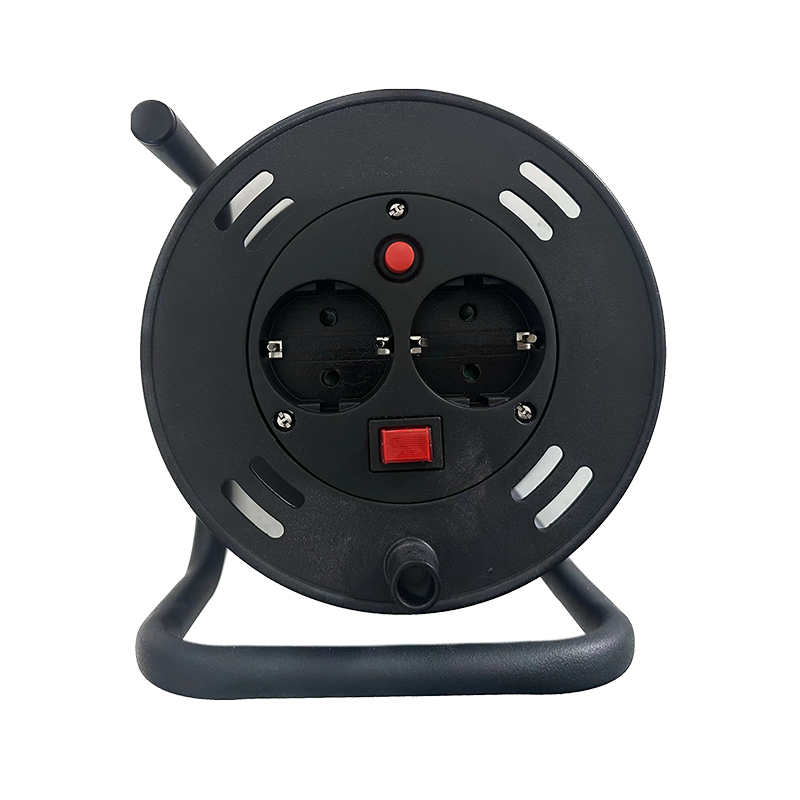
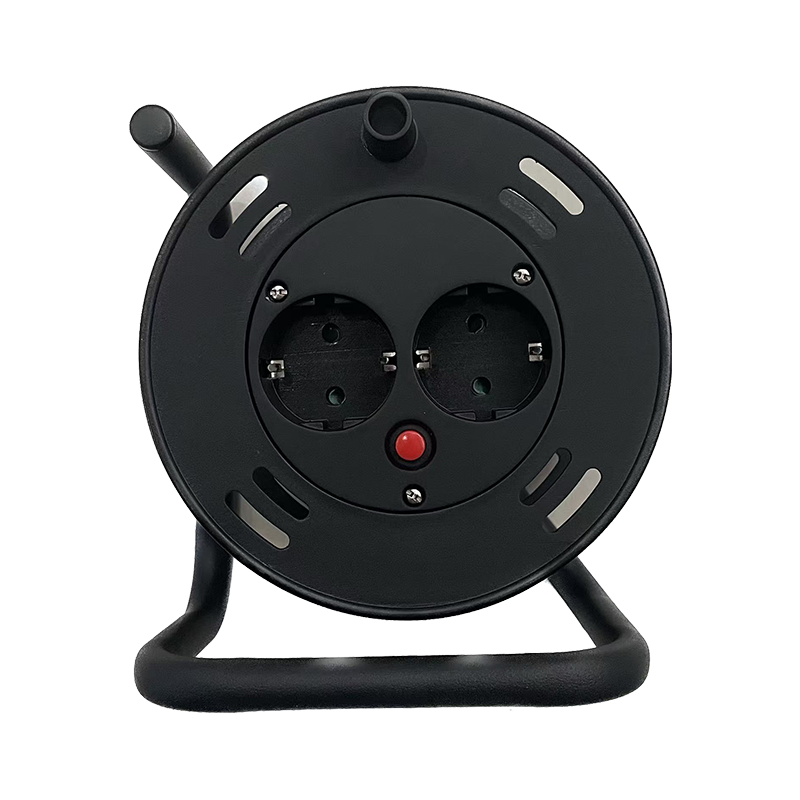
- Industrial cable reels protect the cable from abrasion, UV and tangling, and are available in indoor, outdoor and industrial versions with IP44 sealing and CEE outlets.
- Industrial extension cords use H07RN-F rubber or neoprene sheathing for outdoor and heavy-duty use, where a PVC indoor cord would stiffen and crack in cold weather.
- Industrial timer sockets add 24-hour mechanical or digital switching to the CEE connection for pumps, compressors and lighting.
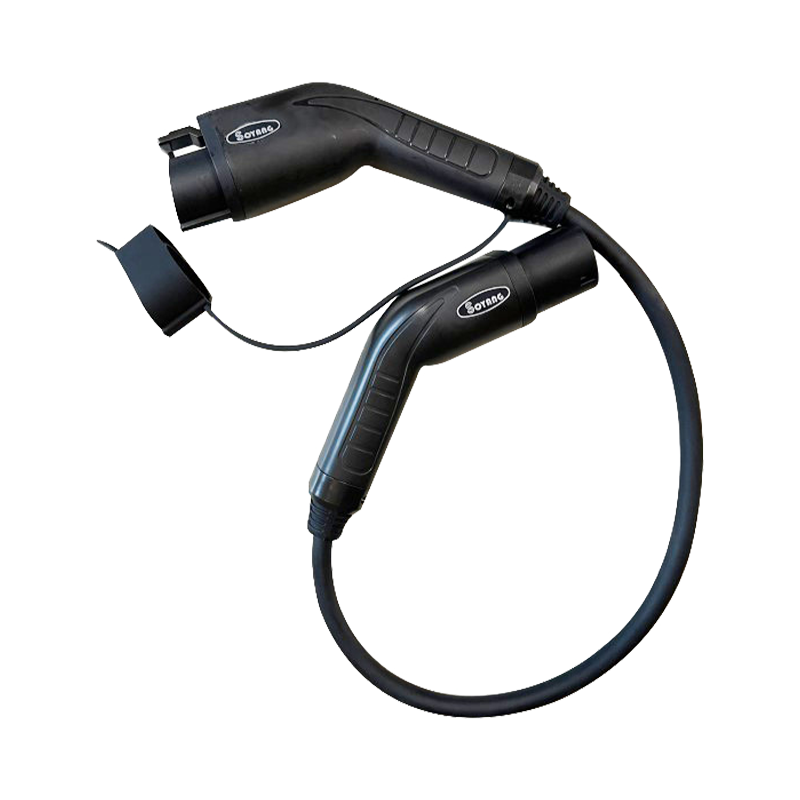
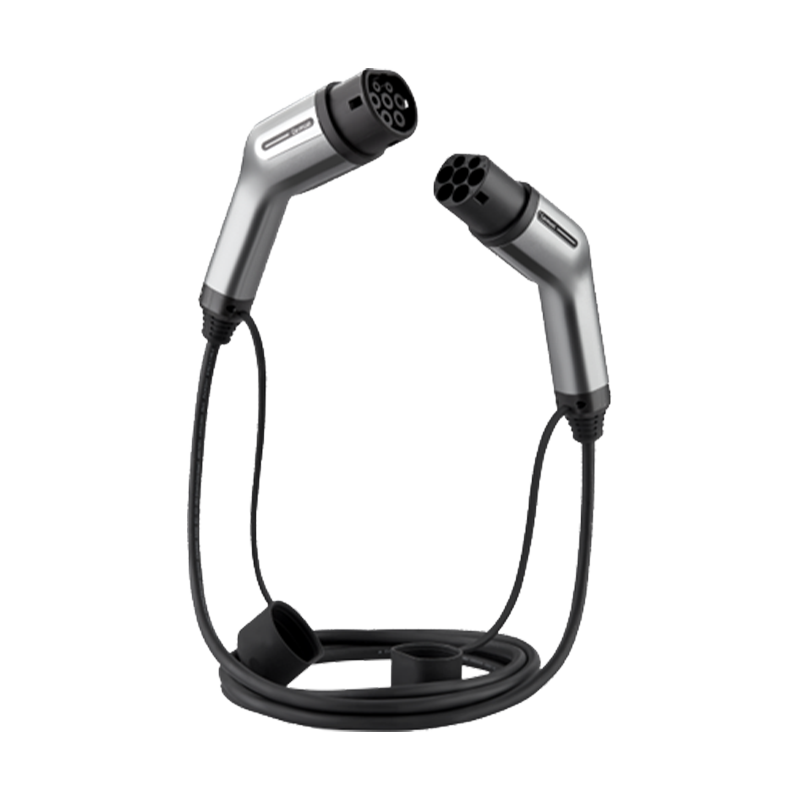
- EV charging cables in Mode 2 and Mode 3 configurations bring the same connector logic to vehicle charging, with additional requirements on heat dissipation and bending life.
- Waterproof boxes and cable organisers keep connections out of the weather and keep loose cable off the floor.
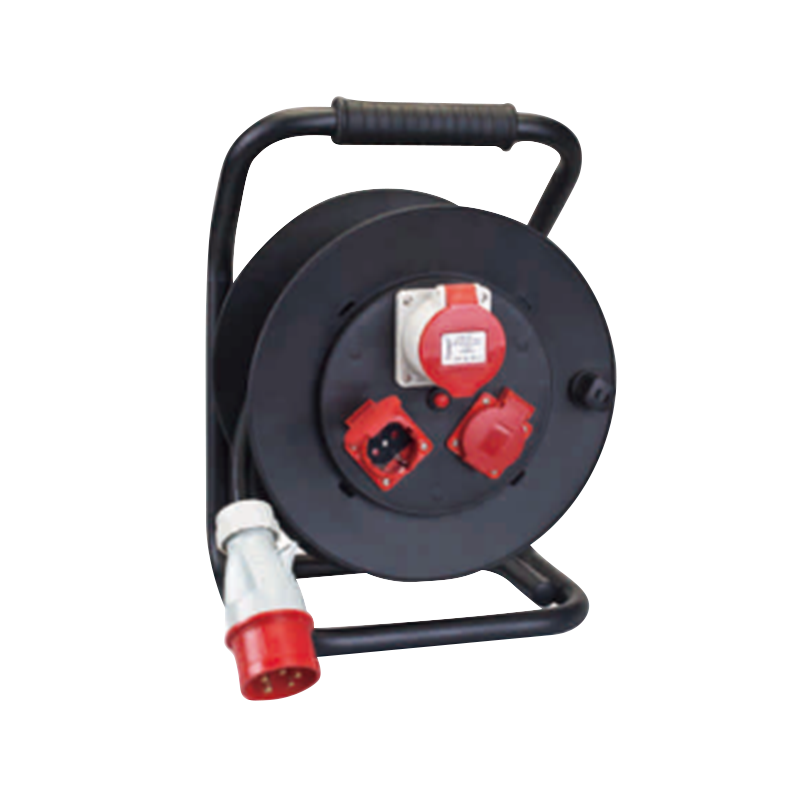 XP06-SY51-D 16A/380V Industrial Cable ReelOEM/ODM 16A/380V cable reel rated for up to 20 m H07RN-F cable, with one 380V and two 230V sockets and IP44 protection.View Product →
When a project needs a complete package rather than individual parts, the sensible approach is to look at the load list as a whole: current, voltage, poles, cable length, environment and the number of times the connector will be mated each week. Those six answers determine the socket, the plug, the cable and the reel in one pass, and they remove most of the guesswork from the order.
What to Verify Before Placing an Order
Buyers who source industrial sockets from a factory rather than from a catalogue usually care about four things beyond price: whether the ratings on the label are real, whether the materials are consistent between batches, whether the certification documents match the market, and whether the specification can be held steady over repeat orders.
- Rating consistency: confirm the tested temperature rise at rated current and the conductor range actually accepted by the terminals.
- Material traceability: housing compound, contact material and plating should be stated on the drawing, not left to the supplier.
- Testing capability: an in-house test laboratory with dielectric, temperature rise, IP and endurance equipment reduces the risk of batch drift.
- Certification: CE, VDE, NF, GS, ETL and RoHS documentation should reference the exact model, not a family name.
- Repeatability: ask how a second and third order will be matched to the first, including colour tolerance and moulding tool wear.
A manufacturer with its own moulding, assembly and testing lines can usually hold a specification across orders more easily than a trading operation, because the variables being controlled are in one building: compound selection, tool maintenance, terminal torque and final inspection. For anyone building a fixed bill of materials for an export project, that stability is worth more than a small difference in unit price.
Frequently Asked Questions
What is the difference between an industrial socket and a normal socket?
An industrial socket is keyed, colour coded and rated for higher continuous currents, typically 16 A and above, and it seals to IP44 or IP67. A household socket is not keyed, is limited to a single-phase supply, and generally offers no sealing, which is why the two cannot substitute for each other.
Can I plug a 230 V appliance into a 400 V industrial socket?
Only through the correct combination socket or an approved adaptor. A 400 V three-phase socket with a neutral provides 230 V between phase and neutral, but the connection must be made through a device designed for that purpose. Forcing a plug into a socket with a different hour position is never acceptable.
What does the hour position on a CEE socket mean?
The hour position describes the clock position of the earth pin relative to the keyway. It is a mechanical safety feature assigned according to voltage and system, so a plug with the wrong hour position physically cannot be inserted into the socket, even if the current rating matches.
Is IP44 enough for an outdoor installation?
IP44 resists splashing water and is usually adequate outdoors when the socket is under a canopy, mounted with the cable entry facing downward, and not exposed to jets or standing water. Exposed positions, washdown areas and locations where water can collect should use IP67 devices.
How often should industrial sockets be inspected?
A practical baseline is a visual check every month, terminal torque and seal inspection every quarter, and electrical tests such as earth continuity and insulation resistance once a year. Sockets in high-vibration or high-cycle environments should be checked more often.
Why does the plug or socket become hot during use?
Heat almost always indicates resistance somewhere in the current path, most often a loose terminal, a relaxed contact spring or an undersized cable. Discoloured housing near a terminal is a reliable warning sign and the circuit should be isolated and checked before further use.
Can industrial sockets be used for electric vehicle charging?
Yes, in many installations a CEE socket supplies a charger or a portable charging unit. The differences are that the load is continuous for long periods and the protection requirements are more specific, so the socket rating, cable size and upstream protective device all need to be confirmed rather than assumed.